




New ocean model launched for Scottish salmon industry
The Norwegian ocean modelling company Oceanbox has launched a new high-resolution ocean model designed specifically for Scotland.


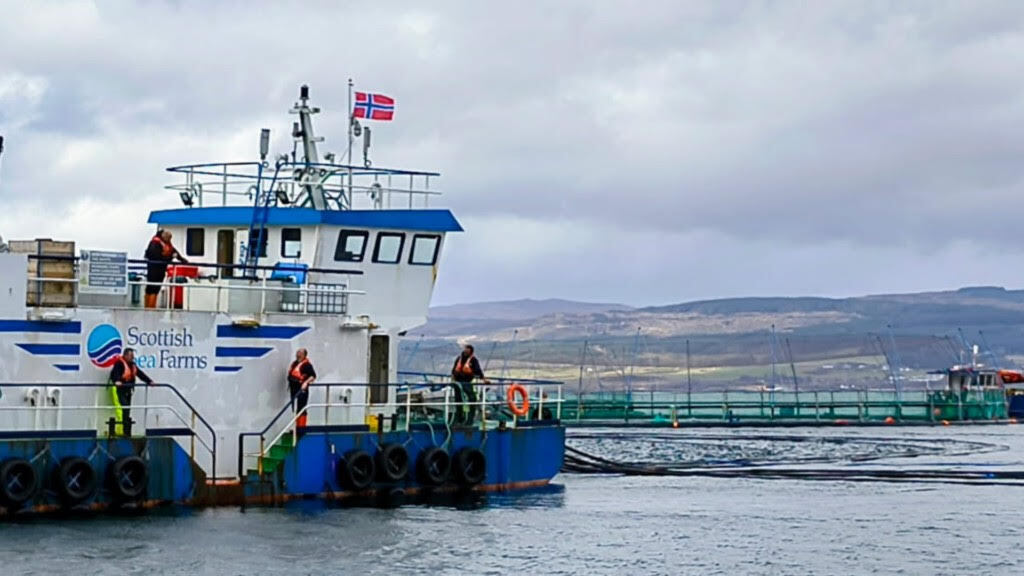
A warm welcome to Oceanbox from Scottish Sea Farms during their visit to Scallastle Marine Farm in April
The move marks the company’s first major international expansion which it says makes the Oceanbox platform available in one of the world’s most important aquaculture regions.
The new model area enables users to simulate ocean currents, particle dispersion, sea lice transport, water exchange, and environmental impacts across Scottish coastal waters – directly within Oceanbox’s cloud-based platform.
The company says that although Scotland is the world’s third largest producer of Atlantic salmon, the coastline was characterised by complex fjord systems, strong tidal currents, and highly exposed farming sites, creating significant demands for environmental understanding and operational planning.
Svenn Hanssen, CEO of Oceanbox said: “Scotland represents one of the most exciting and demanding aquaculture markets in the world.
“Traditionally, this type of ocean simulation has been both time-consuming and resource-intensive to set up. With Oceanbox, users can get started much faster.”
Over the past few years, Oceanbox has developed high-resolution ocean models covering the entire Norwegian coastline. Today, the platform is used by several leading aquaculture companies, including Mowi, Lerøy, Salmar and Cermaq.
The company says it has established itself through user-friendly and powerful simulation tools for aquaculture, environmental mapping, and marine operations. The platform allows users to run advanced simulations without requiring in-house modelling expertise.
For Scottish aquaculture companies and marine consultants, the new model area opens opportunities for improved site planning, environmental analysis, biological risk assessments, and operational decision support.
The Scotland launch also marks the beginning of Oceanbox’s broader international expansion strategy.
Our ambition is clear: we want to make advanced ocean modeling accessible where the industry needs it most, says CEO Hanssen..
Oceanbox says that as environmental requirements and operational complexity in aquaculture continue to increase, accessible and scalable ocean insight will become increasingly important for the future of fish farming.
...
Hatchery RAS Technician (Lochailort) - Mowi Scotland
Lochailort, Lochaber£28,258 to £35,265 per annum
Sales Support Administrator/Marketing Assistant - Wyvex Media
Hybrid home/office - Oban or Edinburgh areaCompetitive Salary
Deckhand / Relief skipper Tiffany II - Kames
KilmelfordFrom £33,000 per annum
Marine Engineer - Scottish Sea Farms
Shetland£43,800 - £48,000 per annum
Hatchery Technician (Anglesey) - Mowi Scotland
Holyhead£28,258 to £35,265 per annum
You May Also Like




© 2026 Fish Farmer.