





Caring for crustaceans
Back in June this year, animal welfare campaigners staged a protest outside an Iceland store in London to draw attention to welfare issues in the retailer’s seafood supply chain.



This wasn’t about finfish welfare, however – the International Council for Animal Welfare (ICAW) was calling on Iceland to end what the campaign group saw as cruel practices in shrimp production.
Invertebrate welfare has long been an overlooked area, but that is changing fast.
Already, several retailers including Marks & Spencer, Waitrose, Tesco and Sainsbury’s have committed to improvements in shrimp welfare in their supply chains.
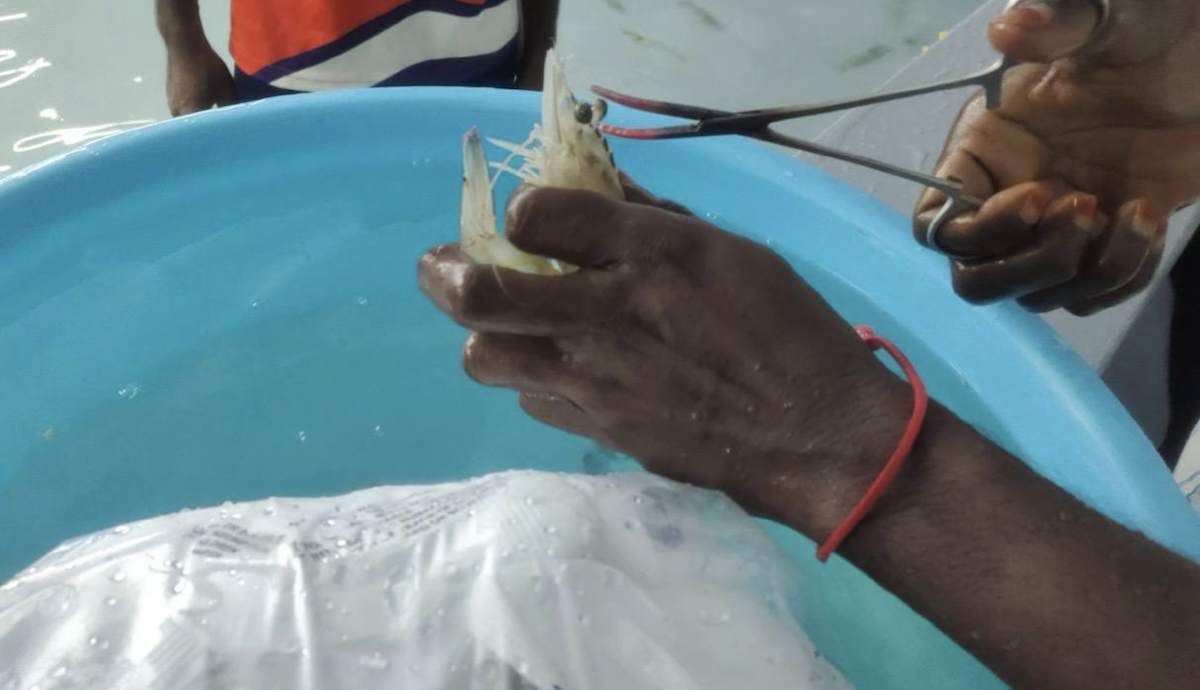
The key issues for the protesters at Iceland, led by their mascot “Mr Prawn”, were twofold. First, slaughter methods and the need to end reliance on killing by immersion in ice slurry; and secondly, the practice of eyestalk ablation, which involves cutting the eyestalks of females in order to enhance and regulate egg production.
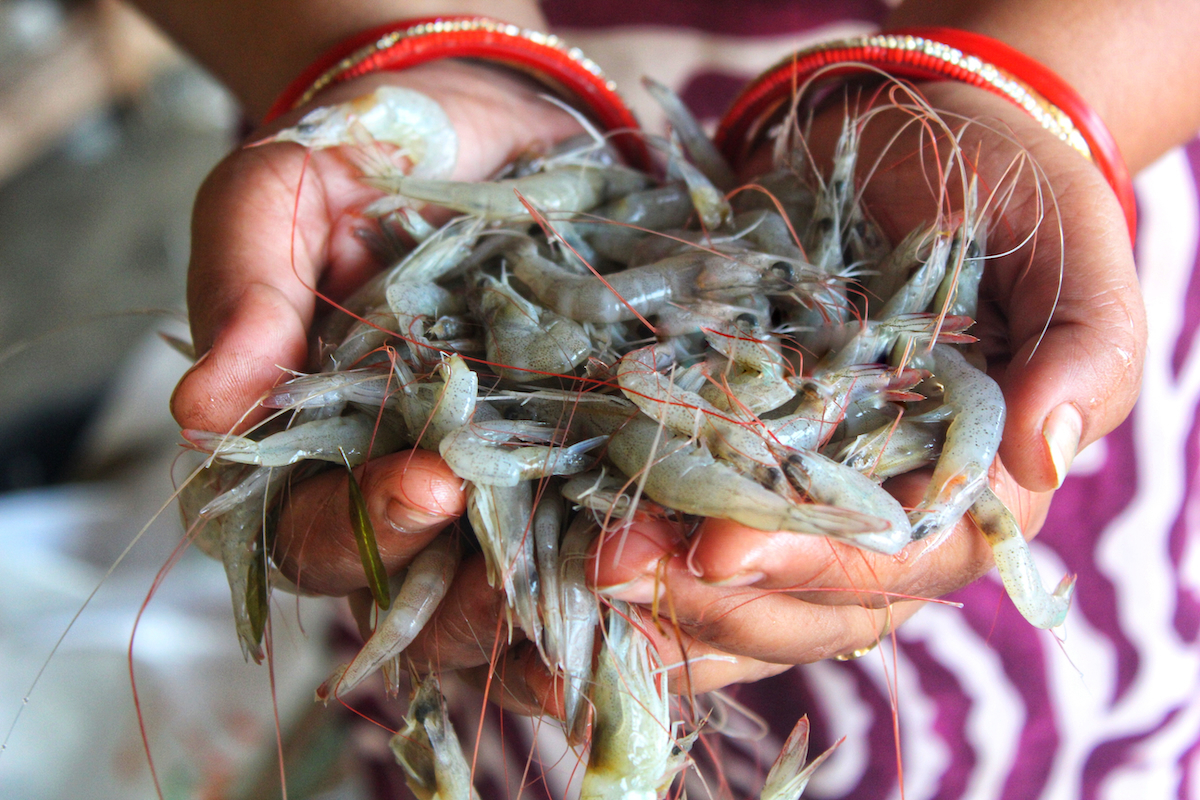
Around 440 billion shrimp are slaughtered each year. They are typically produced in the “Global South”, in countries like Ecuador, China, India and Vietnam, and consumed in the wealthier north.
Shrimp can feel, too
There is a growing consensus that decapod crustaceans like shrimp should be counted among sentient animals, capable of experiencing pain and distress.
In 2005, the European Food Safety Authority published its Scientific Opinion on the “Aspects of the Biology and Welfare of Animals Used for Experimental and Other Scientific Purposes” in which decapod crustaceans were classified in Category 1: “As a consequence of this evidence, it is concluded that cyclostomes, all Cephalopoda and decapod crustaceans fall into the same category of animals as those that are at present protected.”
Category 1 includes all animals that meet the following definition: “The scientific evidence clearly indicates that those groups of animals are able to experience pain and distress, or the evidence, either directly or by analogy with animals in the same taxonomic group(s), are able to experience pain and distress.”
In the UK, in November 2021, the London School of Economics and Political Science published a review of the scientific evidence on the sentience of decapod crustaceans and cephalopod molluscs, stating: “We recommend that all cephalopod molluscs and decapod crustaceans be regarded as sentient.”
Another argument for change is that eyestalk ablation, as well as being seen by consumers as a distasteful practice (when they find out about it), is potentially unnecessary. Research suggests that good welfare procedures result in better animal health and improved survival rates, without jeopardising commercial production (Zacarias et al, Aquaculture 2021).
Two leading seafood standard-setting bodies, the Aquaculture Stewardship Council (ASC) and the Global Seafood Alliance, which sets the Best Aquaculture Practices (BAP) standards, have said the producers in their certification schemes will need to start phasing out eyestalk ablation and ice slurry as a slaughter method unless it is combined with electrical stunning.

Humane slaughter
Better slaughter methods were in the spotlight at the TCRS (The Responsible Centre for Seafood) Shrimp Summit, held in Bali in August.
Professor Amaya Albalat, of the University of Stirling, presented results from laboratory-controlled and field trials on electrical stunning and chill-killing of shrimp.
Laboratory trials showed that ice slurry, the most commonly used slaughter method, is effective in immediately stopping visually evoked responses (VERs) from shrimp but tail flipping behaviour (a typical shrimp response to the discomfort caused by very cold temperatures) remains. Its duration is shortened in super-chilled ice-slurry (-2.5 C), Professor Albalat explained.
Tail flipping induced by exposure to ice slurry can be suppressed by electrically stunning the shrimp; however, consistency can be an issue, she added. Farm trials conducted so far indicated that the combination of electrical stunning followed by ice slurry increases stunning efficiency compared to electrical stunning or ice slurry in isolation.
Professor Albalat emphasised that the results are based on one farm and one type of electrical stunning technology and should therefore not be extrapolated to other farm systems or technologies.
Also at the summit, Simão Zacarias, a post-doctoral research fellow at the University of Stirling’s Institute of Aquaculture and the session chair, presented a gap analysis on aquatic animal health and welfare that revealed how voluntary sustainability standards don’t adequately take into account factors such as disease management, slaughter, reproduction and life stages.
Zacarias also outlined strategies that can help hatcheries move away from eyestalk ablation, including shifting to a high-quality broodstock diet, adjusting male/female sex ratio, and choosing the right broodstock strains.
The panel discussion that followed the individual presentations generated several takeaways, including:
• Transitioning to a high-welfare practice needs to happen gradually
• Better data (with scientific and commercial validation) regarding practices/methods can help farmers and processors make the transition
• Simple and reliable methods are needed to verify that shrimp are produced from non-ablation hatchery systems
• More research would shed insight into consumer purchasing behaviour and perceptions around shrimp welfare
• More communication with NGOs and retailers can provide better clarity regarding welfare improvements.
ICAW’s update on the leading retailers reports that, as mentioned earlier, some of the biggest names in retail have already moved on shrimp welfare. Sainsbury’s and Tesco, for example, have committed to ending eyestalk ablation and introducing electrical stunning for the shrimp in their supply chains by 2026 (for L.vannamei, the Pacific whiteleg shrimp), and Co-op says it will do so by the end of 2027.
Les Mousquetaires, a French-owned retail group that includes the brands Netto and Intermarché, says it will end ablation next year and bring in stunning by 2030. Aldi is relying on the ASC rules, which means it could take until 2031 for its shrimp supply to be entirely welfare-friendly, and Lidl and Asda have not yet set out their policy.
In July 2025, just a month after the London protest, Iceland also committed to eliminate eyestalk ablation, and introduce stunning, for its own-brand shrimp by the end of 2027.
It looks like Mr Prawn has won the argument.
Why not try these links to see what our Fish Farmer AI can tell you.
(Please note this is an experimental service)
You May Also Like






© 2026 Fish Farmer.