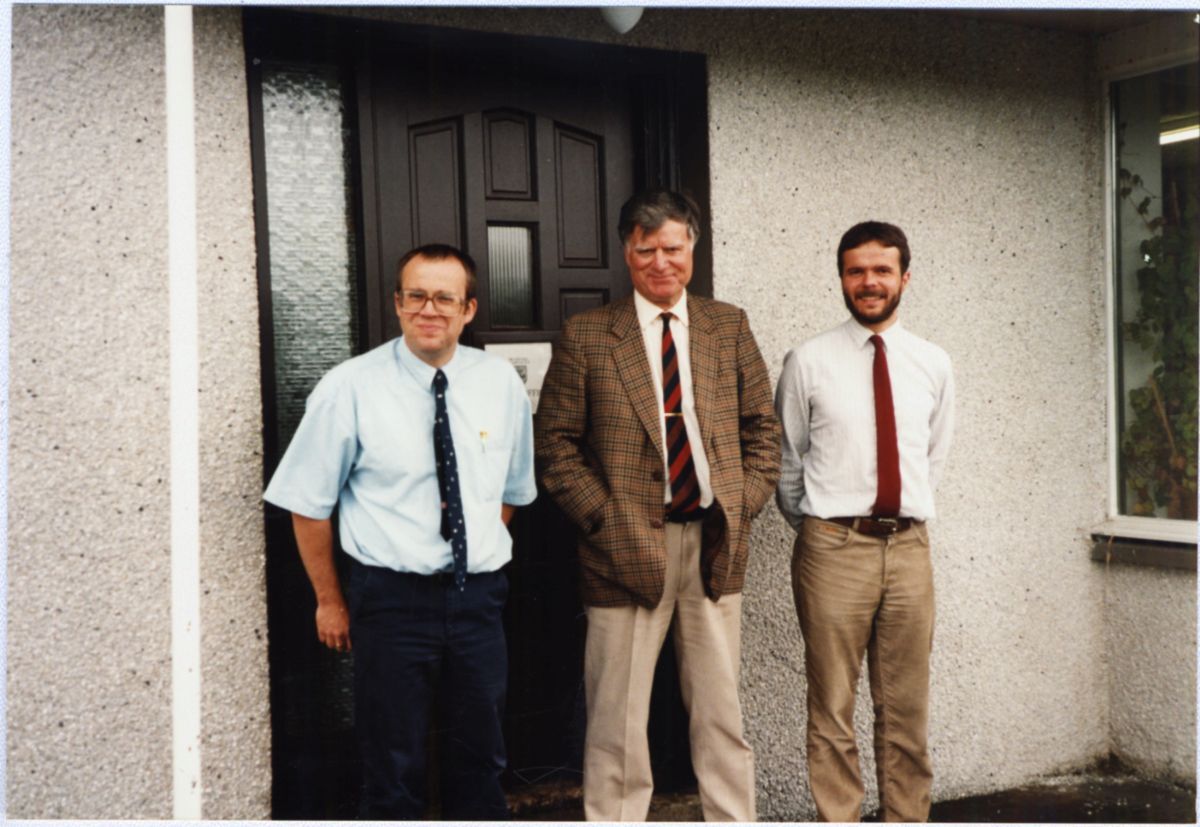
Former Managing Director of Marine Harvest, David Richard McCarthy, has died.
He passed away on 3 December 2025. Mr McCarthy was MD of Marine Harvest from 1988-1994.

As witness to the impact that he had on the business and its people, the tributes that flowed for him at the time of his funeral were numerous and enlightening.
“I will take a quiet moment on the 16th to reflect and pay my respects to a wonderful man and an inspirational leader.”
“He was an inspiring version of a senior leader: authentic and engaging.”
“Always charismatic and affable even in the most difficult times.”
“All of us at Marine Harvest owed him a big debt of gratitude for his decisive leadership over a number of years.”
“He was an exceptional boss and a great person.”
“It was the little things that he did that made him such a huge presence.”
“He will be remembered not only for taking the business forward, and establishing it as the world leader, but also for the manner in which he did so, with a wonderful mixture of humour, compassion and, above all, incisive thinking.”
Unilever
David McCarthy took over as Chairman of Marine Harvest, Unilever’s aquaculture enterprise, in 1988 at a time when the business was experiencing significant losses. Prior to arriving at the company, David had enjoyed a wide and distinguished career within Unilever, which he had joined in 1961 straight from Oxford University and National Service.
Starting in Elida Gibbs he moved swiftly through the ranks to become Marketing Director.
He was then promoted to become Chairman of Unilever Malaysia, where he swiftly made his mark, before further promotion to become Chairman of Unilever Chile. That was where he first became involved with salmon farming, as Marine Harvest were proposing to set up Atlantic Salmon farms in the country.
As chairman of the local company, he swiftly became enthusiastically committed to the project. A number of key staff had been sent to Chile from Scotland, and David provided them with all the support that was necessary to bring the project to a relatively swift conclusion, with the very successful transfer of the technology.
The impact of his arrival in Scotland in 1988 cannot be overstated; fish health issues and an over-supplied international market had resulted in troubling financial results. At the time Marine Harvest had around 30 sites on the west coast of Scotland.

In an interview with Fish Farmer Magazine for Mowi’s 50th anniversary special, which was published in 2015, David said: “When I joined things were very problematic. Marine Harvest had a dominant position within the Scottish industry, but the company had been expanding rapidly and had all the problems associated with that. We had too many fish, too many fish on each site, a lot of disease, and morale was quite low. I felt that my remit was, effectively, to turn the company around.”
What David brought to the company was a wealth of experience of managing fully-integrated businesses comprising factories, distribution, marketing and sales. So, he was quick to grasp the fundamentals of salmon farming and the problems the company faced, though freely admitting that he knew next to nothing about the farming process itself.
Inspiring boss
In managing the business over seven years, David proved to be an inspiring boss, in the sense that the whole management team and staff were happy to follow his lead. The reason was, and is, clear.
Firstly, he was an incisive thinker, disturbingly so at times, and rarely failed to see the wood for the trees; he was sympathetic and compassionate to all who worked with him, which, combined with his easy nature and a wonderful sense of humour, made him a man with whom it was good to be around.
The consequence of this, plus a bit of luck that usually surrounds success, he turned the company completely around, so that when it came time to sell the business in 1992, as part of Unilever’s decision to withdraw from Agribusiness, the company was the leading salmon farmer in the world and poised for further achievements.
David said in the interview in 2015: “As part of the deal, I stayed to run Marine Harvest. And by the time I retired in 1995 – when Hanson sold the business to Booker McConnell – we’d turned the business around and it was starting to make money.”
The key to changing things was, as David said: “a matter of getting out and speaking to the troops. I was also helped by having very good people, men such as my colleagues on the Board, John Lister and Angus Morgan, and Ralph Baillie and Steve Bracken on the ground.
“After listening to the farmers, we went to the top of Unilever and told them we were going to halve the number of fish in each site. We explained that they would lose money initially, but to keep the faith. So, in spring 1989/90, we drastically reduced the number of fish. It took two or three years to get everything right, but we were confident that we had the right approach.”

Another important thing they did at this time was focus on reducing the stress on their fish.
“Stress and disease go hand in hand in an alarming way,” David said. “One of the ways we successfully reduced stress was stopping cleaning the nets with the fish in situ. We began leaving two pens empty, into which we would swim the fish whilst we cleaned the nets. Counting fish had always been a stressful operation.
They had to be lifted out of the sea to be counted in a gutter by someone with a clicker, which was very primitive. So somebody came up with a device that counted, and graded, the fish as they swam from one pen to another. These were all important innovations.”
One of the other innovations during David’s leadership, one that was pioneered by Marine Harvest, was the fallowing of lochs.
David said: “Water exchange on most of the lochs is around 37 days. So we decided that fallowing the loch for between six to eight weeks after harvesting would significantly reduce the impact of disease. However, because there were often more than one company operating on each loch, we also realised that fallowing would only work if every farm on the loch did it, and at the same time. This led to the first management area agreement with McConnell Salmon on Loch Sunart.”
The combination of these measures, alongside others, such as the introduction of year-class sites, produced some remarkable results.
“In 1991, within a few months of putting the smolts to sea, we had a larger biomass than previously, with double the number of fish,” David recalls. “The fish were growing incredibly fast; it was a great moment, and a total vindication of our approach. It is certainly one of my proudest moments working for Marine Harvest.”
David left Marine Harvest in 1995 when Booker McConnell bought the business.
He said: “I was asked to stay on, but decided to retire instead. The seven years I was there were absolutely fascinating…an incredible business experience; a memorable and exciting challenge.”
David McCarthy’s funeral took place on 16 December 2025.
*With thanks to Angus Morgan for his contribution to this article.
Why not try these links to see what our Fish Farmer AI can tell you.
(Please note this is an experimental service)