




Talking about a revolution
Aquaculture is one of the fastest-growing food production sector globally, supplying over half of the seafood consumed worldwide. Yet, as demand increases, so do the challenges.
Sea lice are a significant problem for the salmon industry due to the impact they have on fish health, welfare, and farm economics.


Salmon farmers across the world use a growing mix of biological, mechanical and thermal tools to combat sea lice, but to better enable them to do this, a team of scientists from the Scottish Association for Marine Science (SAMS), near Oban on the west coast of Scotland, has, for the last year and a half, been working on a project looking at sea lice larvae.
Entitled “E(tive)lice: Revolutionising sea lice detection for sustainable salmon farming and conservation” the project – which ends in August, and involves the University of Glasgow, Mowi, and Argyll Fisheries Trust, and is funded by BBSRC, the Biotechnology and Biological Sciences Research Council – has been studying sea lice larvae in the sea lochs on Scotland’s west coast to improve the current data models on which farmers depend.
Fish Farmer caught up with Dr Andrew Dale of SAMS, a physical oceanographer and Principal Investigator in Numerical Modelling for the project, to find out how the study was coming along.
He says: “It’s at the larval stage that the sea lice spread from one fish to another, but that’s the part of their life cycle that is least understood. So, we’ve been focused on trying to understand how sea lice move around.”
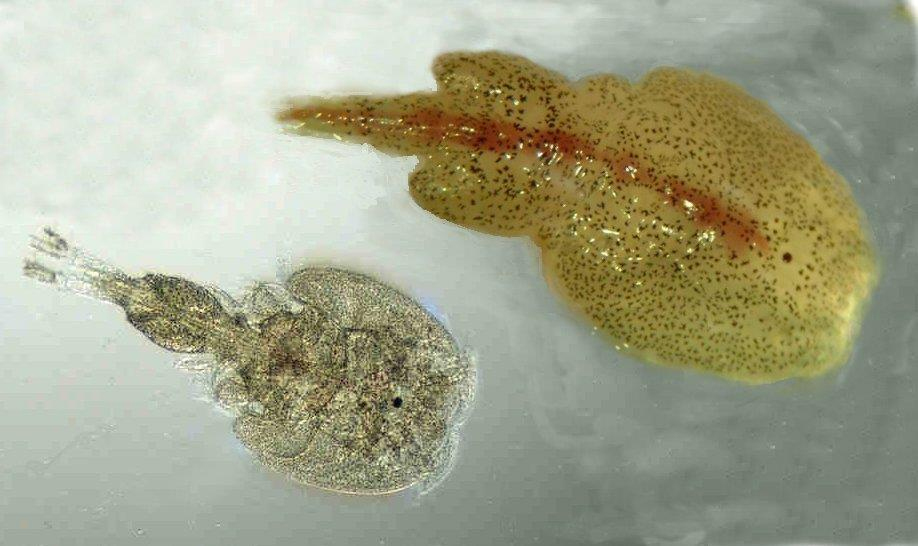
Which sounds a lot simpler than it actually is. It is no easy task to study larval stages in the water column. Sea lice at this point are very small – about half a millimetre – and part of a huge zooplankton community of billions of small organisms.
Dr Dale says: “You’ve got these tiny larvae and they’re at the mercy of the currents. They’re mixed in with many thousands times more plankton in the ocean, and also they have responses to the environment they’re in.
“It’s always been assumed that they tend to concentrate at the surface because they have an attraction to light. But they also respond to salinity – they don’t like really low salinity waters, so if there is a fresh water inflow they will tend to avoid that. Fresher water from a river tends to spread out across the surface of the sea, so that’s kind of counter to what I just said. They swim up towards the light, but then they tend to avoid the fresher water. So there are all these nuances that affect their distribution.”
Dr Dale is a physical oceanographer and studies the currents and the stratification; the salinity, where the low salinity water is sitting and how thick it is. So he is interested in how the lice interact with all those nuances in the marine environment.
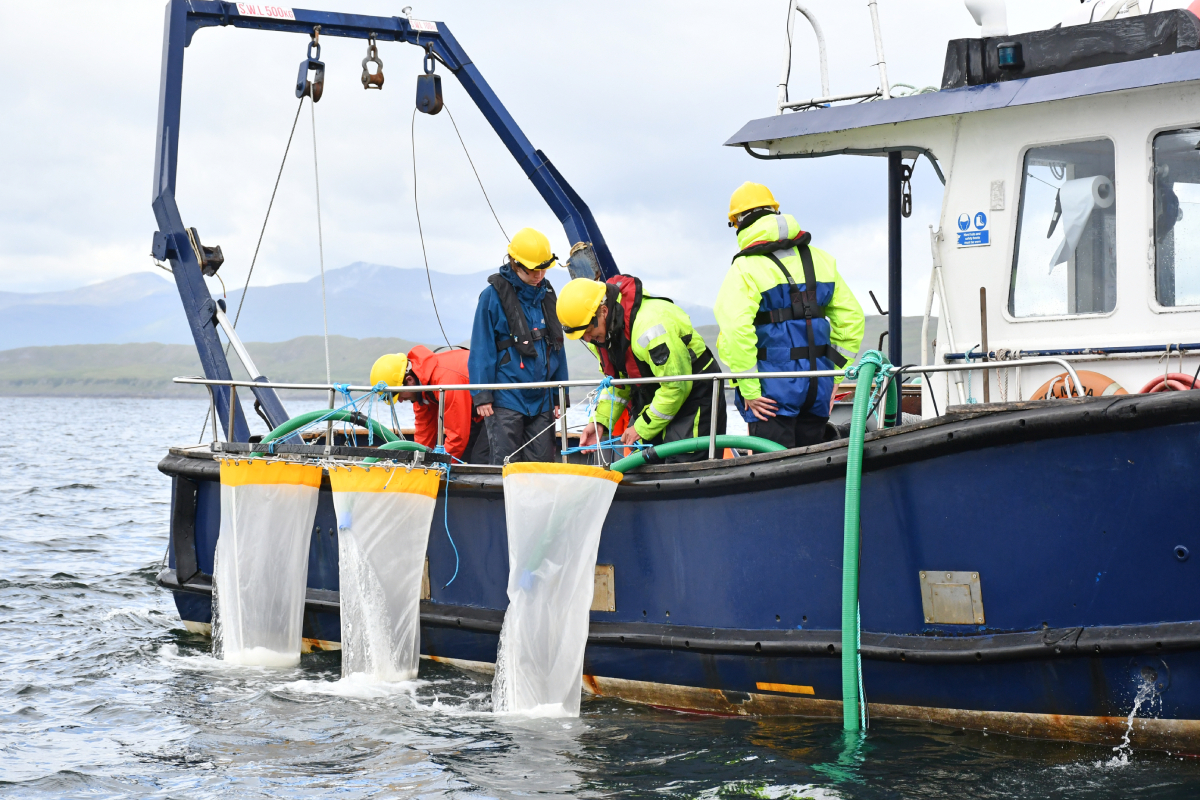
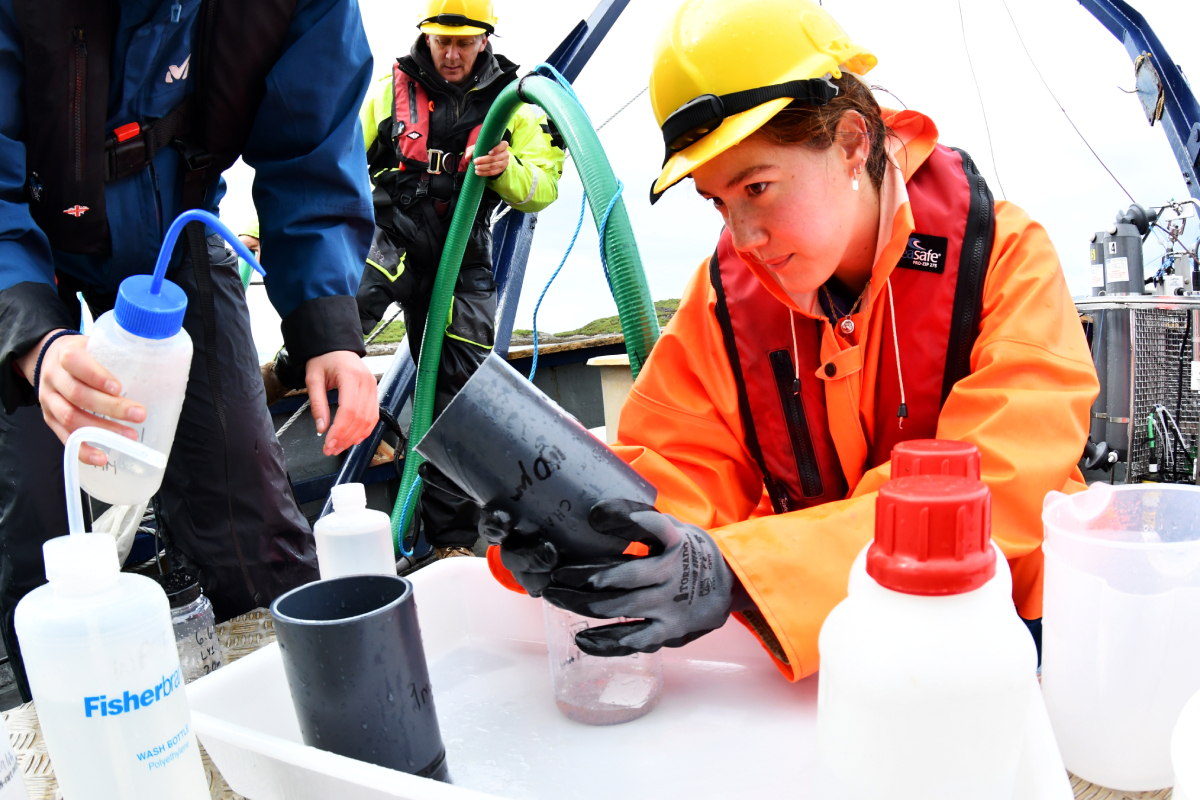
“We’ve been out there on a boat with a plankton net and pumps, sampling at many locations in Loch Etive, and also at different depths, sucking up large quantities of water, filtering it, collecting all the plankton, and then my colleagues have been studying the plankton under a microscope to count the number of sea lice larvae, which means sifting through many thousands of plankton to pick out the one sea louse larvae.
Larvae are parasites, their life depends on them being able to find a new host, and that makes finding them in the marine environment a challenge; trying to figure out where the lice are, where in the water column they are, and where they end up.
Dr Dale continued: “That’s where what I do as a physical oceanographer comes in. We understand how the currents work in sea lochs, and it’s quite complicated. The water at the surface is heading out to sea, while the water below is moving in the opposite direction. So depending on where the lice position themselves in the water column, they can get right up to the head of the loch, or they can get swept out to sea. So their survival depends on how attuned they are to the vertical differences in what the currents are doing.
“There’s an awful lot of complexity there, both in the physics and how the sea lice larvae interact with it. So that’s what we’re trying to get to the bottom of, to improve the models by understanding things better.
“We’re running computer models as simulations of how the sea lice larvae move around between different aquaculture farms, and we’re using the actual numbers of lice we’ve captured at various locations to help tune the models, to get them working as well as we can.”
Dr Dale says the work done so far has taken the models on quite a bit further.
“We’ve got this great inter-disciplinary team. Dr Helena Reinardy is leading the project. She has a lot of past experience in sea lice, also she’s coming from a more biological perspective. Dr Kim Last is an expert in zooplankton behaviour. My colleague Dr Tim Szewczyk is a key modeller, and he’s doing great things with the modelling.
“One of the problems with the modelling is there is so much uncertainty to many aspects of it, and people often shoot down models because they are not perfect – and modellers absolutely acknowledge that. But we want to improve all those uncertainties to clarify things and get them working better.”
Dr Szewczyk has been using a technique called ensembling – the same technique is used in weather forecasting – running models with many slight variations in the behaviour of the sea lice. For example, including how fast the louse can swim vertically in the water column, or how low a salinity is enough to make it not want to be at the surface.
Dr Dale said: “All these things are basically numbers that you put into the model, and the outcome will change as a result. We don’t know these numbers exactly. There are some assumed salinity preferences, which come from lab studies decades ago, where sea lice were in a tube with waters of different salinities. Those numbers have been used over and over again, so Tim allows for a bit of uncertainty in those aspects and runs many, many models with slightly different combinations of all these uncertain parameters, and they all have different outcomes.
“However, he can combine those into an ensemble model of what the sea lice are doing, which actually performs better than any of the component models. He can also look at which of the component models did the best job. As a result, using some machine learning and Bayesian statistics, he aims to actually improve the estimates of all these behaviours of the sea lice, and regularly improve the models based on performance. it’s an ongoing process where you tweak the models when you get more data, and you look at how the model’s performed, then you tweak them a little bit more, and so on.
“We feel we’re incrementally getting closer and closer to models that are more and more useful in terms of predicting how sea lice larvae are moving around.”
As well as Loch Etive, the team have been sampling out towards the island of Lismore and into the Firth of Lorn to help them understand what conditions are like outside of Loch Etive.
“Loch Etive is a special environment in many ways,” says Dr Dale. “In terms of the sea lochs in the west of Scotland, it’s unusually fresh because it’s got an awful lot of fresh water inflow and it’s quite a constricted loch, but also long. The upper basin of Loch Etive is a long way from the Firth of Lorn, which is saltier and can flush that fresher water out with the tide, so it’s quite a nice environment for us to be measuring sea lice in order to understand how they are behaving, because you’ve got these differing salinities, and you can see what the lice are doing in response to that salinity.”
As far as fish farmers are concerned, it is hoped the improved models that will result from this study will help them fine tune their strategies to counteract the lice. With more accurate models, they can better understand what’s coming and can treat their fish accordingly, or use fallowing strategies.
Dr Dale continued: “We’re currently working with Mowi, which has all the farms in Loch Etive at the moment, and they adopted a policy of fallowing all the farms in the loch simultaneously to break the transmission cycle of the lice. There are wild fish in the loch as well, but by fallowing all the farms at the same time, rather than fallowing one farm and leaving a reservoir of lice on the remaining farms, the idea is to break that transmission cycle.”
One area that the team have been particularly interested in is how deep sea lice can be found.
While no farmers in Scotland are currently using semi-enclosed farms for salmon, there are many proposals under consideration. The idea behind the design is that they enclose the farm from the surface water, using an impermeable barrier under the surface around the fish, drawing in water from depth.
Dr Dale explained: “It’s typically been assumed that lice are attracted to light and therefore swim right up at the surface and are moved around by the surface current.
“But that’s based on relatively slim evidence, and there have been measurements of lice at greater depths than people have typically assumed. So we’ve been sampling not just at the surface but at multiple depths, and we have been finding them down at 30 metres and more.
“I wouldn’t say that has been a surprise to us, but I think it’s important for people to understand that sea lice larvae can get to significant depths, and we don’t know the deepest they can get to. So if farmers using semi-enclosed farms are drawing in water at depth, they could potentially draw in very much unwanted sea lice.”
With only a few months of the project remaining, the team are now spending part of their time focusing on the next project.
“We’ve got really nice data from last year, from various times of the year, and we’re looking to add to that, in particular to understand where the lice are in the water column, and at what depths, and how they are responding to the cycle of light at the surface.
“They almost certainly have some form of migration cycle down through the water column, which is poorly understood and based on fairly scant evidence in the natural world.
“There are experiments that have been carried out in labs with light and tanks, measuring what the lice do, and so on, but to go out into the natural marine environment and sample sea lice at different depths, at different times of day and tide, when the light falling on the water surface is varying, including at night, you’re going to get a lot more understanding of that.
“Again, that feeds into the models, because if they are moving up and down through the water column when people were previously just sampling them during the day time, they might see them at a certain level in the water column. But if you assume they were always there, the models would be wrong. So, we want to confirm where they are at different times of the day.
“We’ve done most of our field work, but this is hopefully just a little bit of a pilot study for setting up the next project. We’re using our remaining energy and funds to go out and chase down some of the things we don’t quite know all about.”
Why not try these links to see what our Fish Farmer AI can tell you.
(Please note this is an experimental service)
You May Also Like





© 2026 Fish Farmer.