




Fish health: challenges just won't go away
Norwegian aquaculture, and salmon farming in particular, continues to face major challenges. That’s the message according to a new analysis from the Norwegian Institute of Marine Research, which has recently published a risk report on the sector.


For the fish farmers, it doesn’t make for happy reading.
According to the Directorate of Fisheries, the number of dead farmed salmon at sea last year was 54.9 million plus an additional 13 million dying in other environments.
Within that total some 2.5 million fish were discarded at slaughterhouses along the coast.
The report is about more than bald figures. It digs deep into some of the problems facing an industry which gave birth to modern aquaculture.
It says Norwegian aquaculture production increased sharply between 2024 to 2025 – by more than 200,000 tonnes.
This is the largest annual growth figure since 1980. Salmon accounted for a full 182,000 tonnes of the increase, rainbow trout went up by 13,000 tonnes and cod farming by some 5,500 tonnes.
Although production is increasing, this year’s risk report shows that the industry still has a lot of work on its hands.
Poor animal welfare in fish farms and the negative effects of sea lice on wild fish are still the biggest obstacles to achieving sustainability, says the report.
And high water temperatures, more fish in the sea and more frequent delousing have worsened the situation.
The report says, however, that the escape rate in rivers has largely stabilised, but the risk of genetic changes in wild salmon is still high in four production areas. In some areas, including production area six, the risk is increasing due to several escape episodes in 2024 and 2025.
The report adds that the use of copper in fish farm nets increased between 2023 and 2024, but is still far lower than in 2019.
The risk level is assessed as being unchanged from last year, but there is a need for more knowledge about tralopyril, another antifouling material used as a replacement for copper that has seen an increase until 2023, but which decreased slightly in 2024.
The Institute found that the current consumption of delousing agents posed a low risk of serious effects on other marine species, but warns that if the extent of treatment continues to increase, that risk level may change.
The risk from catching and using wild wrasse for delousing is also considered low, and harvesting of wild wrasse is now so low that 2026 will be the last year with a separate assessment of this, as long as the situation does not change.
Measuring the risks
The report assesses risks in nine areas, including fish welfare, sea lice, genetic impact on wild salmon, environmental effects on bottom conditions, discharges of nutrients, copper and the use of chemical delousing agents and cleaner fish.
Rising temperatures, leading to warmer seas, are starting to throw up some serious problems for the industry
The last two summers (2024 and 2025) were particularly problematic, leading to very high sea lice levels, which put a particularly heavy burden on sea trout and sea char, which spend a long time in the coastal zone.
Increased production in northern Norway further increased the risk.
“Although there is little knowledge about how future marine heatwaves will affect sea lice infestation, the risk assessments are largely unchanged from last year,“ says the report.
“Two production areas have a high risk of sea lice-induced mortality in wild salmon smolt, eight have a moderate risk and three have a low risk.
“For sea trout and sea char, the situation is significantly worse, but unchanged from last year: nine production areas have a high risk, two have a moderate risk and two areas have a low risk.”
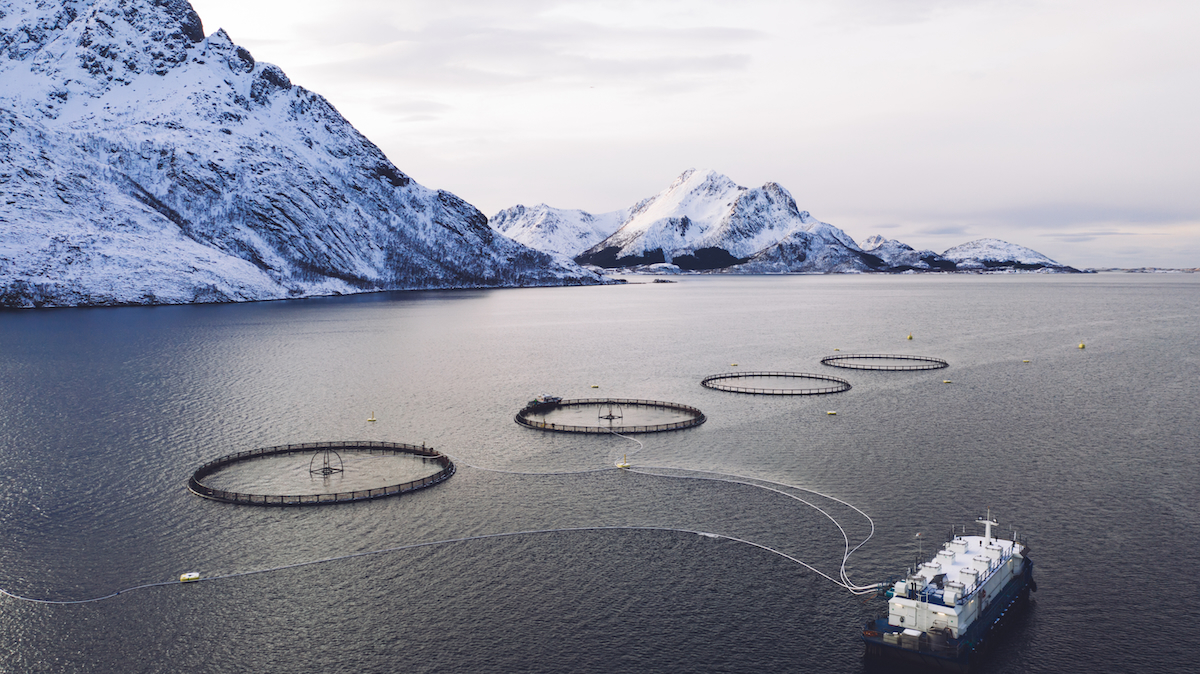
Submerged cages are now being used at 40 locations to reduce lice infestations, but this still represents a very small proportion among the estimated 900 locations in Norway.
The report warns that the marine heatwave that occurred along the Norwegian coast throughout last autumn shows that climate change is already affecting the marine environment.
A separate risk assessment with a climate focus is therefore planned later this year.
It points out: “Since the volume of farmed salmon began to increase, the parasite sea louse has been a problem, and sea lice infection of wild salmonids is today the chosen environmental indicator that places limits on further growth in Norwegian salmon farming through the traffic light system.
“With a traffic light system, quality standards for wild salmon stocks, the Water Directive, monitoring of the environment and food safety, lice regulations and a comprehensive set of legislation for both aquaculture, food and animal welfare, Norway is at the top of the world for knowledge-based management of aquaculture.
“Nevertheless, it is difficult to get a comprehensive picture and common understanding of how big the challenges related to environmental impacts and animal welfare are in the Norwegian aquaculture industry, and how this affects the sustainability of Norwegian fish farming.”
Why not try these links to see what our Fish Farmer AI can tell you.
(Please note this is an experimental service)
You May Also Like




© 2026 Fish Farmer.