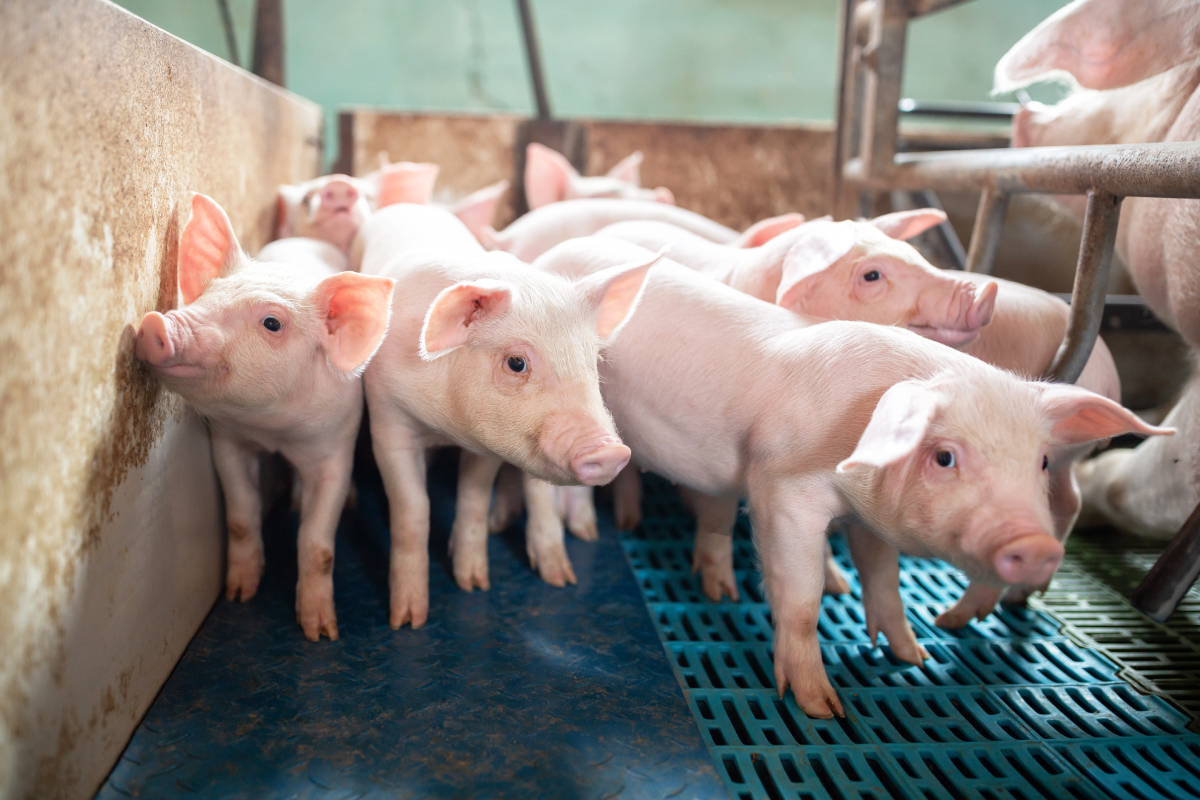

In May, the University of Edinburgh’s Roslin Institute announced that gene-edited pigs, produced to be resistant to one of the world’s most costly livestock diseases using technology developed by the Institute, had been approved for sale to US consumers.

The US Food and Drug Administration approved the use of a gene-editing technology that makes pigs resistant to porcine reproductive and respiratory syndrome (PRRS) for the US food supply chain.
This landmark approval for animal genetics company Genus, following years of development, the Institute said, helps meet the challenge of a disease that is endemic to most pig-producing regions.
The infection, which causes fever, respiratory distress and premature births, costs industry approximately $2.5 billion (£1.75bn) each year in lost revenue in the US and Europe alone.
The approval follows years of close collaboration with the FDA and is a significant step on the pathway to commercialisation of gene-edited pigs in the US, and other international markets.
Researchers at the Roslin Institute focused their efforts on the CD163 gene in pigs. This gene produces a receptor on the surface of cells, which the PRRS virus uses to cause infection.
Experts removed a small section of this gene, focusing on the section of the receptor that the virus attaches to, leaving the rest of the molecule intact.
Supported by Edinburgh Innovations (EI), the University of Edinburgh’s commercialisation service, the team collaborated with Genus, which also licensed novel technologies from other institutions, to produce pigs with the specific DNA change.
The resulting pigs do not become infected with the virus, and the animals show no signs that the change in their DNA has had any other impact on their health or wellbeing.
Professor Bruce Whitelaw, of the Roslin Institute, said: “We are delighted to see the PRRS-resistant pig gene-edit approved for use – this is a milestone in the use of gene editing in livestock, and a landmark moment for the livestock industry towards managing a global disease that causes devastating losses.”

Gene editing, using technology such as CRISPR, differs from genetic modification (GM) in that only genes naturally occurring within a species are used. The effect of the technology is to speed up a process which could be achieved, over a much longer timescale, with selective breeding – hence its alternative description as “precision breeding”.
Gene editing for farmed animals is still off the table in the UK – for now. The Genetic Technology (Precision Breeding) Act, which gained Royal Assent in 2023, allows the commercial cultivation of gene-edited crops in England only. It does, however, allow for future government regulations to permit gene editing for animals, subject to strong safeguards, at some point in the future.
Supporters of gene editing had been concerned that the increased alignment with the European Union, agreed in principle at the UK-EU summit in May, would halt the introduction of gene editing for crops in the UK.
Trade publication Farmer’s Weekly reported, however, that the UK government is clear that gene editing is not included in that alignment. DEFRA Secretary Steve Reed confirmed to the paper that the government’s commitment to advancing precision breeding technologies had not changed, saying: “We are somewhat ahead of the European Union. We continue with the legislation… the door remains open to an agreement around that.”
Why not try these links to see what our Fish Farmer AI can tell you.
(Please note this is an experimental service)