The clue is in the name. Loch Long, a sea loch in the Loch Lomond and The Trossachs National Park, stretches fully 20 miles from the Firth of Clyde up to the village of Arrochar, cleaving the peninsulas of Rosneath and Cowal in Argyll.

And it has been a lengthy saga for Loch Long Salmon to build Scotland’s first commercial scale semi-closed fish farming facility, in the shadow of Beinn Reithe.
The Edinburgh-based firm first submitted its planning application back in 2021, with the hope of becoming operational in 2023. But after opposition from many residents along the fjord, a rejection from the National Park Authority, an appeal to the Scottish Government, delays to a decision, and Ministers’ consent in August 2025, Loch Long Salmon (LLS) can finally start building its dream.
Semi-closed cages are one of several solutions that can help address the challenges facing the aquaculture industry.
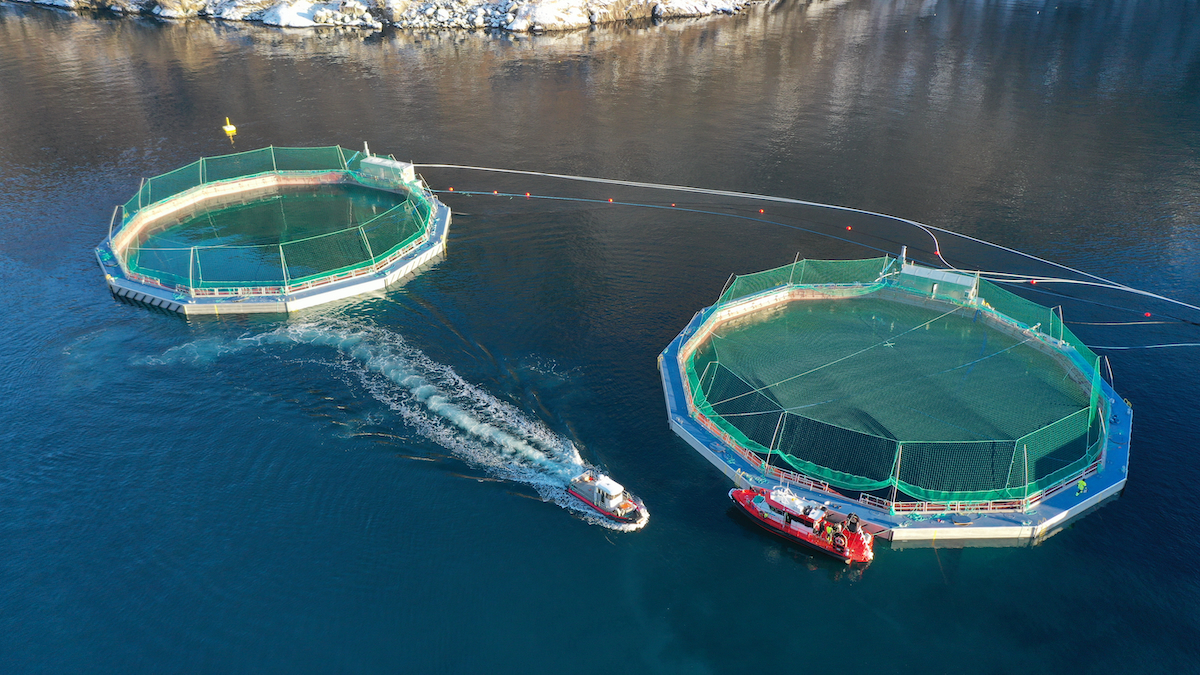
“From the surface a semi-closed containment site looks like a traditional salmon farm,” LLS explained, “but underneath the water, the net is surrounded by an impermeable membrane, with water drawn up and circulated from deeper in the loch.
“This removes the threat of sea lice and attacks by seals, meaning it won’t ever use sea lice treatments or acoustic devices that can harm dolphins or other cetaceans.
“The lack of medicinal or other treatments needed for sea lice has been shown to improve the welfare of the farmed fish overall, and to prevent breeding populations of lice establishing in the enclosures, preventing retransmission to wild salmon and trout.
“Hundreds of cycles of this technology in other countries have proven these facts, as well as showing no escapes.
“The farm will also capture more than 85% of the organic waste that is produced. This will be used as a fertiliser ingredient or in green energy production.”
Why build in Loch Long, in the middle of a National Park? LLS explained: “While the site would not be suitable or economical for conventional open net aquaculture due to its low current, it is ideal for Scotland’s first semi-closed farm, due to its sheltered location, deep water, geographical isolation from other salmon farms, and proximity to a suitable shore base location.”
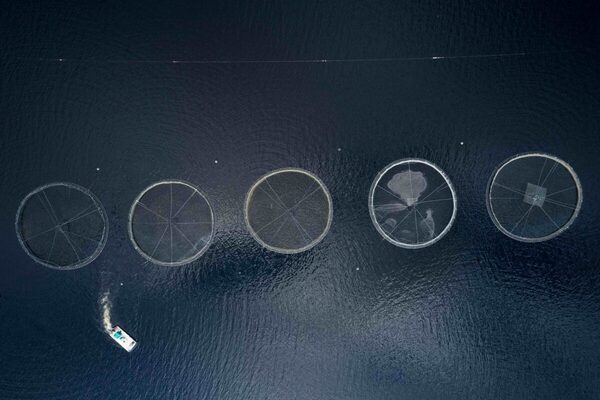
The planned farm comprises four circular enclosures, each with an outer diameter of up to 50m, plus a square harvesting facility with a side length of up to 50m, all sitting in single file in an 80m x 80m mooring grid, approximately 300m from the western bank.
Locally, LLS promised, the farm would represent up to £40m of investment to the rural economy, plus create 12 full-time jobs, and a £100,000 community benefit fund every year for a minimum of 20 years.
However, the plan attracted 192 objections, far more than its 67 supporters. It was recommended for refusal by a planning officer at Loch Lomond and The Trossachs National Park, and board members agreed, 10 votes to one, at a public hearing in Arrochar’s Three Villages Hall in October 2022.
Concluding its ruling, the board’s then Convener, James Stuart, said: “Such a nationally important landscape is not the appropriate location to host development of such an industrial scale, and where the risk of an escape of farmed fish could impact on designated water courses.
“The proposed development also presents a number of significant landscape, seascape and visual issues. It would have an industrial character and would notably contrast with the largely undeveloped and remote character of the local landscape.
“The semi-closed containment systems proposed – whilst noted as a substantial step forward for the industry – have not yet been trialled in Scotland and there is not a sound body of evidence on which to base decision making.”
LLS’s then Managing Director, Stewart Hawthorn, reacted: “The National Park Board has missed an opportunity to sensitively use the natural resources within the park to support local communities and fulfil its mission to improve the wider environment beyond the borders of the park.”
Four months later, in February 2023, LLS lodged an appeal to the Scottish Government’s Planning and Environmental Appeals Division (DPEA).
“We believe the National Park’s decision to prevent this proven, transformative technology being brought to Scotland for the first time was based on fear and a lack of knowledge and understanding,” Mr Hawthorn said.
“The National Park has no experience of handling this kind of application and, rather than listening to experts such as NatureScot, SEPA and Forestry & Land Scotland, who all said the project could go ahead, they based their view on a misunderstanding that our plans were the same as existing open net salmon farms. This is fundamentally flawed.
“The project would also demonstrate the commercial viability of this farming system and place the area at the forefront of sustainable economic growth, while overcoming environmental concerns about existing salmon farming techniques.”
Campaign group AFFtheClyde, which had successfully fought the application, countered: “While this new technology certainly goes a long way to tackling the sea lice problem, it presents other potential dangers. The claim that the technology had been successfully tried and tested is, at best, questionable.”
Their cause was backed by the Scottish Green Party, which launched a campaign urging the Scottish Government to reject the appeal. Over 4,000 supporters joined the call. Highlands and Islands MSP Ariane Burgess said: “Our lochs and the delicate ecosystems they support are too valuable to put be at risk of long-term damage.”

Fast forward to February 2024, and the DPEA Reporter submitted their findings to Scottish Ministers. But it was taking a long time for them to reach a decision – too long for LLS Project Manager Mark Shotter.
“The lack of progress is disheartening,” he said. “Delays to projects like ours risk undermining Scotland’s ability to attract international trade and investment and discourage further innovation. The Scottish Government must act decisively – inaction is not an option.”
At last came a decision in August 2025. The Reporter had recommended that the appeal be thrown out, but after considering the evidence, the DPEA upheld the appeal.
In its decision letter, the Scottish Government said: “The Scottish Ministers acknowledge that the development is larger in scale than open-net fish farms due to the SCCS (semi-closed containment systems) technology.
“The Scottish Ministers agree with the Reporter that fish farm development is inevitably industrial in appearance but consider this should not count against it.
“The Scottish Ministers also agree with the Reporter that no identified ‘important views’ would be significantly affected and that design of the proposed development has sought to minimise visual effect.”
Since the farm supported the development and marine plans and offered economic benefit, they ruled the pros outweighed the policy conflicts.
A delighted LLS said it “can now progress with its ambitious vision to bring semi-closed containment technology to Scotland for the first time. [It] is already widely used in countries including Canada, Norway and the Faroe Islands, where it is transforming industries by improving the welfare of salmon whilst creating economic benefit and greener outputs.”
How is the technology being deployed around the world? In its publicity material, LSS distributed an image of a semi-closed containment pen in Norway, made by the cage designer and manufacturer FiiZK, that is “similar to the design that is being planned for the Beinn Reithe site development”.
Trondheim-based FiiZK supplies “Protectus”, which it says unites “the best of traditional pens and land-based systems”. “A solid double barrier shields the production volume from the natural surroundings, keeping both the farmed salmon and the environment safe,” FiiZK explains. “Lice free deep water is pumped in, circulated, monitored and regulated. Waste is collected for further treatment.
“The system holds 2,000 cubic metres of production volume, and can farm up to 1 million post-smolt from 100g up to 1kg. It is the latest of all our systems, and is a result of 12 years of knowledge and experience from over 24 delivered closed cages and more than 80 production cycles, with a total of over 30 million fish.
“The result is an energy effective, sustainable production with optimal growth conditions, and a significant reduction in environmental impact.”
Elsewhere in Norway, Mørenot Aquaculture, a supplier of fibre-based products to the fisheries and aquaculture industry, has developed the MarWall. Mørenot explained: “By combining shielding from the surroundings with a controlled system for water pumping and oxygen supply, we can create an optimal, lice-free environment.
“This solution is both easier to operate and more flexible than many other alternatives. In a semi-closed cage, we draw deep water and pump it up to the surface, where it is mixed into the water column. The challenge lies in the natural differences between deep water and surface water, but we have solved this with a specially designed shielding skirt system that ensures proper circulation and mixing.
“A key principle is to handle the fish as little as possible. We have developed two systems based on the same principle, both of which can be retrofitted onto existing cages.
“Both systems use deep lice skirts attached to the sink tube, which can be raised and lowered. For cages without sinker tubes, we design tailored skirts to fit the existing net structure.
“The internal system (Hydro2) consists of 3–4 pumps that draw water from 2–3 metres below the skirt edge and circulate it to create optimal hydrodynamics. Each pump operates independently, with adjustable frequency control, and oxygen can be added when needed. Oxygen levels are automatically regulated by sensors to maintain the desired saturation. Each pump has a capacity of 80 m³/min.
“The external system (Hydro-2) is based on the same principle, but the units are installed outside the net and beneath the walkway. This design is ideal for sites exposed to stronger currents. Unlike the internal pumps, the external Hydro-2 units can draw water from even greater depths, ensuring nearly lice-free intake water. They can also help regulate temperature, either by accessing cooler deep water in warm seas or by maintaining a more stable thermal environment.
“Together, these solutions offer flexibility, reliability, and improved fish welfare, while supporting sustainable and cost-effective salmon farming.”

Across the Atlantic, after trialling a made-in-BC semi-closed technology solution at its farms off the Sunshine Coast region, Grieg Seafood BC installed its system at all three of its farms in Esperanza Inlet, off the west coast of Vancouver Island.
The new CO2L Flow system (pronounced Cool Flow) is a form of semi-closed containment, which allows for farmers to raise or lower custom designed farm enclosures. “In all the trials, farmers noted better growth, lower mortality, better feed conversion rates (meaning the fish are more effective at converting feed into growth), and most significantly – a dramatic reduction in the need for sea lice treatments,” the company said.
Dean Trethewey, Seawater Production, Certifications and Regulatory Director, explained: “The CO2L Flow Max system has taken some tried and true technology, such as sea lice curtains, and paired them with cutting edge aeration technology, to create a completely new system.
“During sensitive wild salmon migration periods or times when we know there is harmful algae in the region, we can lower the barriers on the farm, forming a barrier between the wild salmon and the farmed population, this prevents lateral interaction, and significantly reduces the transmission of sea lice between the populations. The barriers can be fully lifted outside of these periods, allowing the farmed fish to benefit from natural ocean conditions, temperatures, currents, and oxygen levels.”
Managing Director Rocky Boschman added: “We are continuing to look for solutions that will support the recovery of solid waste and ways in which it could be used for some type of value-add product like fertiliser or soil enrichment.
“There is no denying that this new system represents a transition towards what in-ocean farms can one day become.”
The system was installed at all three farms in Esperanza Inlet (Lutes Creek farm, Steamer Point farm and the Esperanza farm) in time for the outmigration of juvenile wild salmon in early 2023.
While LLS once hoped to operate Scotland’s first semi-closed fish farm, given the long delays before a decision, it may now be beaten to it.

Inverness-based Gael Force Group, which supplies equipment, technology and services for farming and catching seafood, has been developing its SeaQureFarm for several years, and is now ready to deploy the first system over the next six months.
Group Managing Director Stewart Graham told us: “SeaQureFarm consists of one or more SeaQureWells which are semi-closed containment pens manufactured from impermeable membrane supported by a floating and sinking structure.
“The system is subject to several patents which have been granted and multiple patents still pending. The system involves pumping cooler seawater from depth in a flow through arrangement, with water exchange every 50 minutes.
“The system has 100% redundancy from peak demand and alternates between pairs of pumps daily. The submersible pumps are extremely high volume, very low energy and very low maintenance (five year maintenance cycles).
“Supplementary oxygen requirements are provided from the leading nano bubble systems in order to maintain growth and health supportive levels of DO at all times. The SeaQureWell has double containment security with an internal SeaQureNet which provides the ability to grade and harvest the fish as well as provide additional security.
“Survival is projected to be greater than 95% and all morts are collected and lifted up out of the well for further processing. Sludge collection is being modelled at c95% collection and returned to barge or to shore for processing.
“Due to the unique design of the system the cost base is very substantially lower than other systems which will lead to the system being a strong commercial prospect for both post-smolt operations and on-growing too.
“Gael Force Group are working with the newly established SeaQureFarming Group and producer partners to build up to five full scale sites in Scotland over the next few years.
“Gael Force Group have been appointed preferred supplier to Dawnfresh Farming, who are planning to deploy a first SeaQureWell at their Ardnish site in Lochaber in Scotland over the next six months.”
Meanwhile Loch Long Salmon has been consulting with the local community on a second option, a bigger semi-closed fish farm on Loch Linnhe at Lurignish, composed of eight 50m pens – double the number at the Loch Long facility. This would make it Scotland’s largest fish farm by volume, but not by size. In 2023 LLS lodged a scoping request with Argyll and Bute Council.
Will that too turn into a long saga?

Why not try these links to see what our Fish Farmer AI can tell you.
(Please note this is an experimental service)