As children, we are always encouraged to share with the others, write Sarah Riddle and Benedikte Ranum. But in the fast-paced and competitive world of adulthood, that lesson can easily be forgotten.

A recent LinkedIn post the other day, by an acquaintance* who supports academics in commercialising their research, suggests that there are two types of people in the world: “fixed-pie people” and “grow-the-pie people”.
The former believe that if they give you a share, it means they get less – so they hoard information for their own advancement. Whereas the latter think differently: they look for ways to increase opportunities for others as well as themselves, and share freely of their knowledge.
In aquaculture, great strides are being made in finding increasingly productive and sustainable ways of farming fish, shellfish and seaweed. But without open and well-directed knowledge exchange, there is a risk that these advances never reach further than academic journals or isolated business processes.
The problem with keeping knowledge bound up within individual organisations is that it can lead to missed tricks: valuable information that could help farmers, suppliers, and policymakers may never reach the people who need it most. Let’s face it, a fish farmer can’t benefit from new findings, products or processes if he or she doesn’t know they exist.
Remember the early days of Covid? Our sector displayed rapid collaboration between businesses and across borders. We shared viral detection protocols, biosecurity strategies, and supply chain adaptations. Urgency dissolved barriers, and the result was an agile and resilient industry response.
But we don’t have to wait for global crises to occur before we start sharing information. When we work together to overcome the complexities of intellectual property, competitive advantage, data transfers and regulatory constraints, we can make knowledge exchange part of our culture. This way, “growing the pie” becomes the norm.
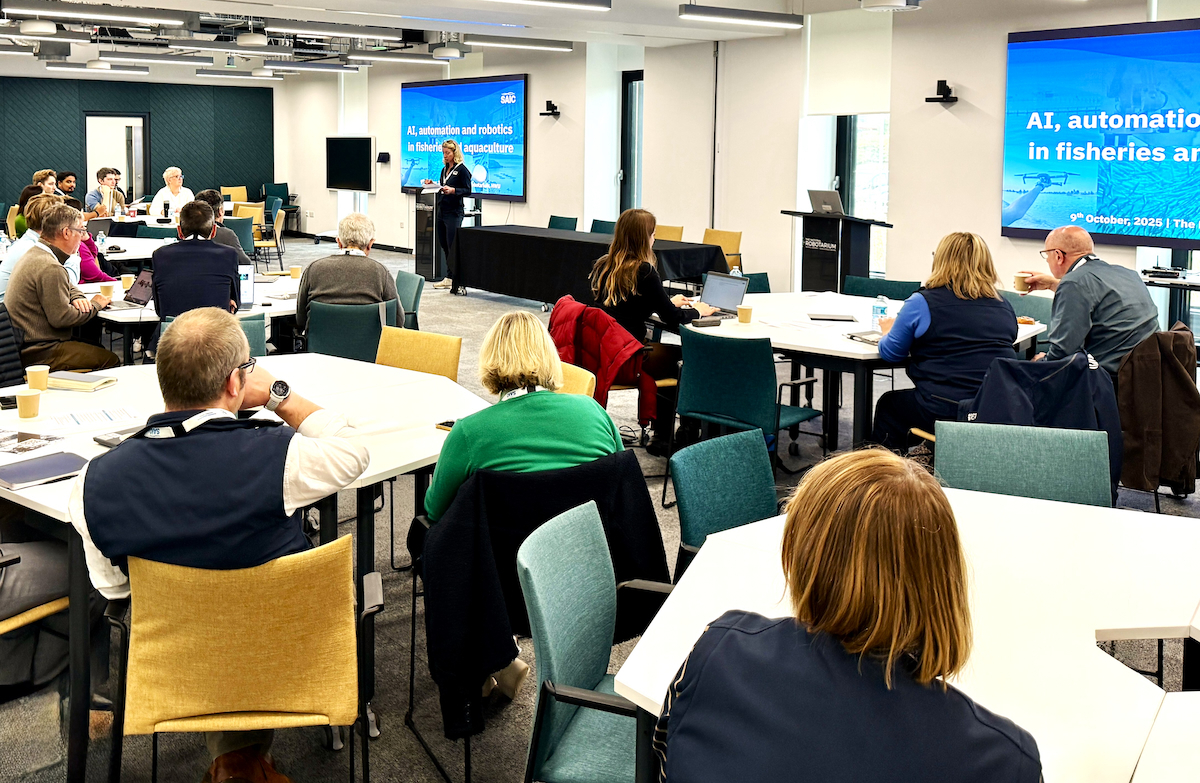
At SAIC, we know that innovation doesn’t thrive in a vacuum. That’s why knowledge exchange forms such a vital part of our activities. In the last quarter, we have held two impactful events: one exploring the application of AI and robotics across the seafood sector, and one delving into strategies for climate-ready salmon farming.
Over the coming months, we will also be fulfilling our ambition to publish a full case study of every SAIC-funded project on our website, and promoting them through engaging animations and social media content. With well over 100 often complex and multi- year projects, this has taken extensive dedication and collaboration, and we are grateful to everyone who has fed into the process. Our website has become
a treasure trove of knowledge gained from the wide range of research we have supported – all freely available to access and download.
But SAIC’s knowledge exchange activities aren’t just about sharing information – they’re about building trust, just like our funded projects have trust as the foundation of their success. Sector professionals can see that scientists understand their challenges, and academics see examples of their work making a real-world difference. New connections are made, and existing relationships are strengthened. Awareness is raised about research already done, so nobody spends time reinventing wheels. And new ideas emerge for follow-up research and implementation.
This way, we help bridge the gap between the lab and the farm, and across geographical boundaries, working together as a strong and well-informed aquaculture sector.
*Zachary Sorrells, Co-Founder of The Research Adventure.
Why not try these links to see what our Fish Farmer AI can tell you.
(Please note this is an experimental service)