




SalMar reports strong fish welfare from Donut
The salmon farming group SalMar has reported stable production, strong fish welfare, and solid biological results from its latest production cycle with the Marine Donut.
The company recently took the Donut from the development phase to full-scale production.


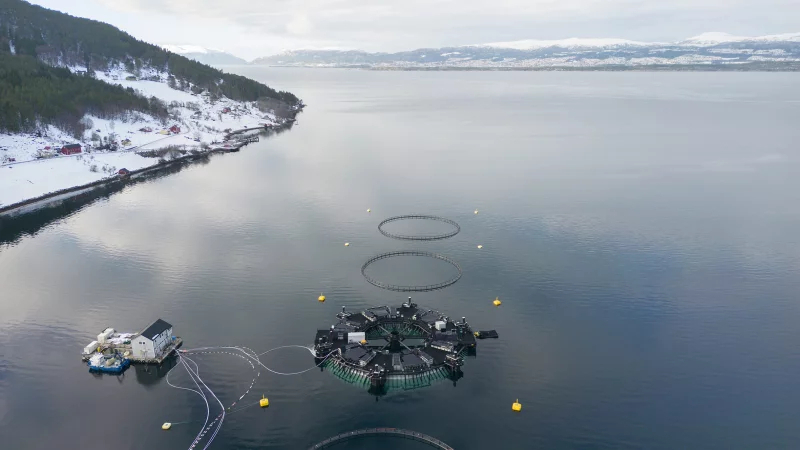
The company reported that one successful fish transfer was carried out,
Summarising its operational experience, SalMar said the key findings included:
- Stable and well-documented water quality throughout the entire period (91.5% average O₂).
- Successful stocking and operations without welfare-related challenges.
- Low mortality, and generally good fish health.
- Strong growth performance, and an economic feed conversion ratio (FCR) of 1.20.
- High product quality, with 90.9% classified as superior grade.
- The system performs as intended, with identified and manageable improvement areas related to feed monitoring and operations.
The report said water quality and environment-based parameters were continuously monitored throughout the entire production cycle.
Oxygen, temperature, salinity, pH, turbidity, CO₂, and algae content were measured in accordance with the monitoring programme, in addition to weekly measurements of total gas pressure and suspended solids.
SalMar added: “The measurements show that water quality in Marine Donut was good and stable throughout the period.
“The average oxygen level was 91.5%, and high feeding rates over extended periods did not have a negative impact on oxygen levels. Mixing of fresh water in the fish volume functions well, as confirmed by consistent measurement values and operational experience.”
The company also says one successful fish transfer was carried out, with a total of 185,196 salmon and an average weight of 3,002 grams. The transfer was completed efficiently and without deviations or fish welfare-related challenges.
“The experience confirms the findings from the first production cycle. Water flow velocity along the bottom of the fish volume is still not sufficient to ensure full transport of dead fish to the dead-fish traps. Measures such as lowering the mixers have improved the situation, and during production cycle 2 no dead fish were observed lying stationary on the bottom.
“Dead fish accumulating on outlet grates remains a challenge, and ROVs have been used to ensure satisfactory dead-fish removal. Further measures are planned ahead of the next stocking.”
SalMar concludes: “Feeding in Marine Donut provided good feed distribution, but camera monitoring is challenging at high fish densities. Feed intake can be observed, but stop signals are difficult to define. This affects the ability to optimise feeding control and is reflected in the biological results.
“Crowding and harvesting of fish were carried out in accordance with a revised procedure. The procedure was adjusted to reduce structural load when the unit is in a raised position.”
Why not try these links to see what our Fish Farmer AI can tell you.
(Please note this is an experimental service)
Engineering Admin Apprentice - Mowi Scotland
RosythSalary On Application
Senior Quality Manager - Mowi Scotland
RosythSalary On Application
Hygiene Department Trainer 2-2-3 Shift Pattern (Night shift) - Mowi Scotland
RosythSalary On Application
HGV Driver - Mowi Scotland
RosythSalary On Application
Assistant Farm Manager (Skipport, South Uist) - Mowi Scotland
Isle of Benbecula£36,169 to £38,995 per annum
You May Also Like





© 2026 Fish Farmer.