




Mortality – the issue that just won’t die
The verdict is in. A year after a Holyrood committee concluded its inquiry into salmon farming in Scotland, and set a 12-month deadline for progress or else, it has now ruled on how well the Scottish Government and industry has danced to its tune. Yet again, we heard the same leitmotif.



In January 2025, nine MSPs on the Rural Affairs & Islands Committee (RAIC) finished their follow-up inquiry, focussing on four themes of fish health and welfare, environmental impact, interactions between wild and farmed salmon, and the location of fish farm sites.
The RAIC was checking progress from an earlier inquiry in 2018 during the previous session of the Scottish Parliament, conducted by its predecessor, the Rural Economy & Connectivity Committee (RECC), which set out 65 recommendations and required urgent action.
When, six years later, the RAIC’s follow-up inquiry revealed its findings, they could be summed up in one word: “disappointment”. Its overarching conclusion was that “the slow rate of progress in improving the regulation and enforcement of the Scottish salmon farming industry needs to be addressed as a matter of urgency, to future-proof the industry and enable it to grow sustainably”.
Its key recommendations on fish mortality, which became the focus of most debate, stated: “Powers to be given to the Fish Health Inspectorate (or another appropriate body) to limit or halt production at sites which record persistently high mortality rates. The Scottish Government should work with industry and regulators to agree appropriate criteria and mortality thresholds for the use of these powers.
“The publication of comprehensive, consistent and transparent mortality figures that include the number of fish at a farm, the freshwater and seawater mortality, per facility, with accurate numbers of dead salmon, wrasse and lumpsuckers per week and with cumulative mortality totals at the end of each production cycle.”
As a spur, the RAIC rejected calls for a moratorium on new and expanded fish farm sites – for now – unless the Scottish Government and industry could show sufficient progress within a year.
We heard the first 12-month progress report on February 25, from the Scottish Animal Welfare Commission, Animal and Plant Health Agency, Scottish Environment Protection Agency (SEPA), Fish Health Inspectorate, Fisheries Management Scotland, and the trade body Salmon Scotland, via a director Ben Hadfield, as covered in last month’s Fish Farmer.
Then, on 11 March, it was the turn of the Cabinet Secretary for Rural Affairs, Land Reform and Islands, Mairi Gougeon, to face MSPs, just before the Parliament dissolved for the May election, when Ms Gougeon will be standing down.
Tough questions were asked by MSPs from all parties present, particularly by the Highlands & Islands’ Emma Roddick (SNP) and Ariane Burgess (Green), but some of the toughest that day came from those in the Conservative opposition.
A fortnight later we got the RAIC’s verdict, and we heard that same refrain again, “disappointment” – but not so much that the MSPs called for a moratorium.
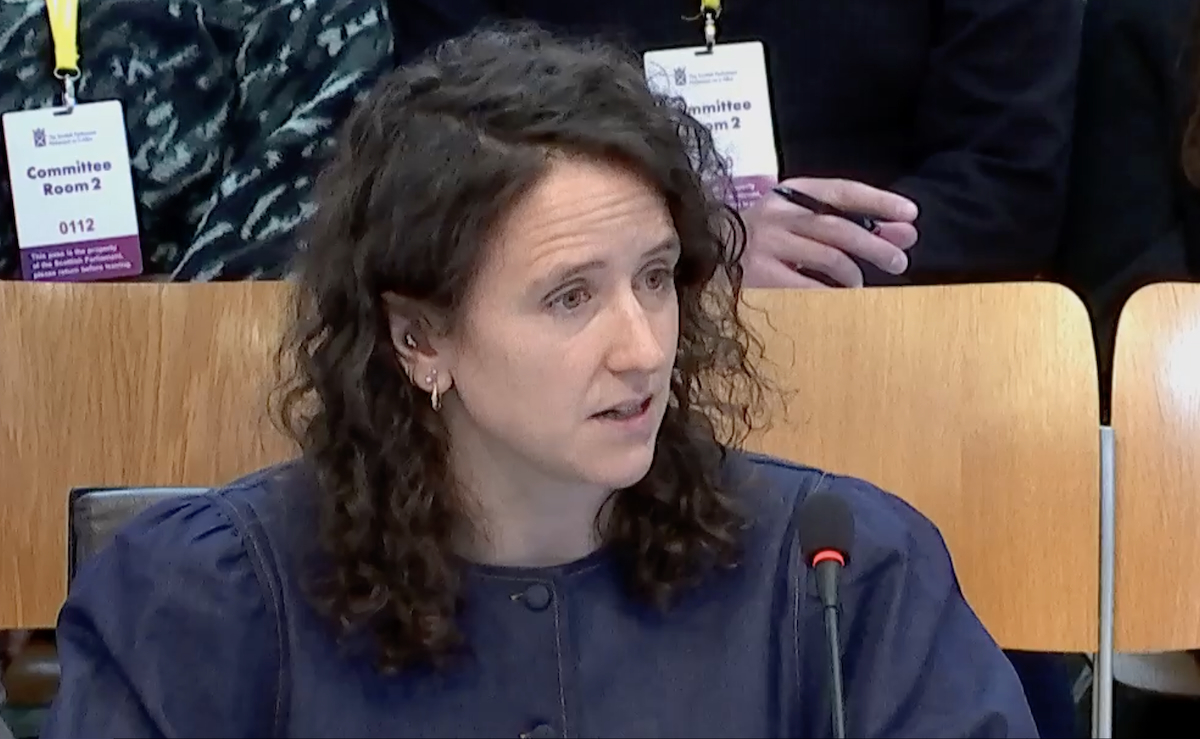
Ms Gougeon, SNP MSP for Angus North and Mearns, began the day of Q&As by listing the Scottish Government’s progress. She said: “Given the concerns that some sites were experiencing persistent high mortality, Scottish Government scientists, fish health experts and policy officials have worked at pace to deliver a robust analytical framework to determine whether such sites exist, what actions are being taken by producers to tackle such mortality and, ultimately, to evidence whether further government intervention is required beyond our existing regulation.
“The preliminary conclusion is that persistent elevated mortality is not a systemic issue for Scottish marine salmon sites. Only a small fraction of sites were identified as having such mortality, and the work showed that all producers already take a considerable range of responsible and prompt actions to tackle and reduce persistent mortality where it occurs. As a result, I do not believe that further regulatory action is warranted at this time. It is still the Scottish Government’s position, which is shared by the industry, that mortality should be managed to the lowest possible levels.
“On fish welfare, I have already committed to progressing welfare standards for farmed fish under the Animal Health and Welfare (Scotland) Act 2006. Delivery will be progressed this year, [with] guidance that is both robust and operationally feasible. We are also strengthening enforcement of farmed fish welfare by working with the Animal and Plant Health Agency to increase the number of trained fish inspectors and the number of inspections that are carried out per year.
“To improve transparency across the sector, SEPA has updated the Scotland’s Aquaculture website to provide better access to important data and information. We have published a mortality data topic sheet to enhance the understanding and use of all the data that is published regarding fish health.
“On spatial planning and consenting, we have delivered on a programme for government commitment to confirm that local planning authorities are responsible for fish farm planning controls and to confirm SEPA as the lead regulator for fish farm discharges within the three to 12 nautical mile zone, thereby future-proofing regulation as fish farms look to move into more exposed locations.
“We have also adopted Scotland’s first regional marine plans: the plan for the Shetland islands region, which we adopted in December last year, and the plan for Orkney, which we adopted in February this year. The adoption of those plans, which marks a significant milestone for marine planning in Scotland, enables a community-led approach to be taken to marine spatial planning, to reflect local circumstances.
“We have also continued to work with SEPA to implement a monitoring programme to support the sea lice regulatory framework. The programme, which is examining sea trout on the west coast, the Western Isles and Orkney, was implemented last year, and, this year, it will be enhanced through the support of the Scottish Government. Although there are appeals relating to elements of SEPA’s framework, appeal mechanisms are part of a fair consenting system, and due process will be followed.”
How transparent is the industry?
Kicking off the questions, the RAIC’s Convener Finlay Carson, Conservative MSP for Galloway and West Dumfries, said: “Back in January 2025, the committee set out clear and practical recommendations that were aimed at reducing persistently high mortality in Scottish salmon farms.
“However, we were told that a requirement to be transparent would be a burden on the industry. Why do you consider avoiding an administrative burden to be more important than ensuring transparency and public confidence in the industry?”
Ms Gougeon replied: “When it comes to mortality data, the salmon farming sector is very transparent with regard to the volume and quantity of information that is published, especially in comparison with other sectors.
“If we are looking to regulate for more information to be provided, it is important that we ask ourselves, ‘Why do we need it?’ We collect the information we need for the purposes of satisfying the regulations that we have at the moment, and we do not feel there is a need to collect further information beyond what is already there.
“A variety of factors and causes can lead to high mortality, not all of which are necessarily always within the control of the fish farmer. We are seeing changing climatic conditions and various other events that can contribute to some of the mortalities.”
Tim Eagle, Conservative MSP for the Highlands and Islands, added: “You have repeatedly said you do not think there is persistent high mortality, yet we do not set a figure for what constitutes high mortality.
“We have repeated evidence of significant mortality – even 80 per cent and above in some cases – and a mortality rate of 20% to 30%, whereas Norway is trying to keep the rate between 5% and 15%.”
Ms Gougeon replied: “You could set a threshold, as other countries have done, but what would that be driving at? What change would that effect or what work would that encourage that is not already happening? Mortality needs to be driven to the absolute lowest levels. That is what we expect, and that is what all businesses are working to achieve.
“The modelling suggests there is not a systemic issue in Scotland, because, wherever a problem was identified, an attempt was made to address it or to try to fix whatever led to the specific event occurring.”
Summing up, Mr Eagle said: “It is about sending a clear message that the Government is genuinely trying to make sure this industry is viable in the future while also protecting our landscape, our seabed and everything else, and ensuring the welfare of the sea salmon population.
“A lot of words have been said this morning, but I just do not think that we are pushing at the pace at which we need to, or that it is all coming together in a package that people can really grasp and see where we are going. You say there is robust regulation, but if there is, it is bitty and all over the place, and I am not sure that it has been there in one place since the 2018 report.”
Mr Carson then ran through some of the RAIC’s recommendations, and compared them with what has been delivered.
He said: “The committee recommended that the Fish Health Inspectorate should have powers to halt or limit production at high mortality sites, but the Government has suggested that no legislative control is justified.
“We wanted there to be an agreement between industry and regulators on mortality thresholds, but what we have are internal definitions used for analysis and not for the identification of any sort of regulatory thresholds.
“We do not have Government-led modelling of environmental drivers. We do not have comprehensive publication of mortality data for cleaner fish, and so on.
“We asked for an annual fish health report, but we do not have a commitment from the Government to produce that.
“Further, although we have an analytical framework, which identifies nine sites, there is no regulatory follow-through to deal with any situations that arise.
“Finally, transparency is a big issue, and we do not have a single data set that allows the public to have confidence that the data that is provided shows that there are improvements in the industry.
“There is a range of reasons why we are not confident that the Government has delivered what the committee recommended a year ago.”

Call for mortality targets
In a final showdown, the last questions were asked by Sir Edward Mountain, the RECC’s former convener in charge of the 2018 report, who, like Ms Gougeon, is also standing down at the 2026 election, as a Conservative MSP for the Highlands and Islands.
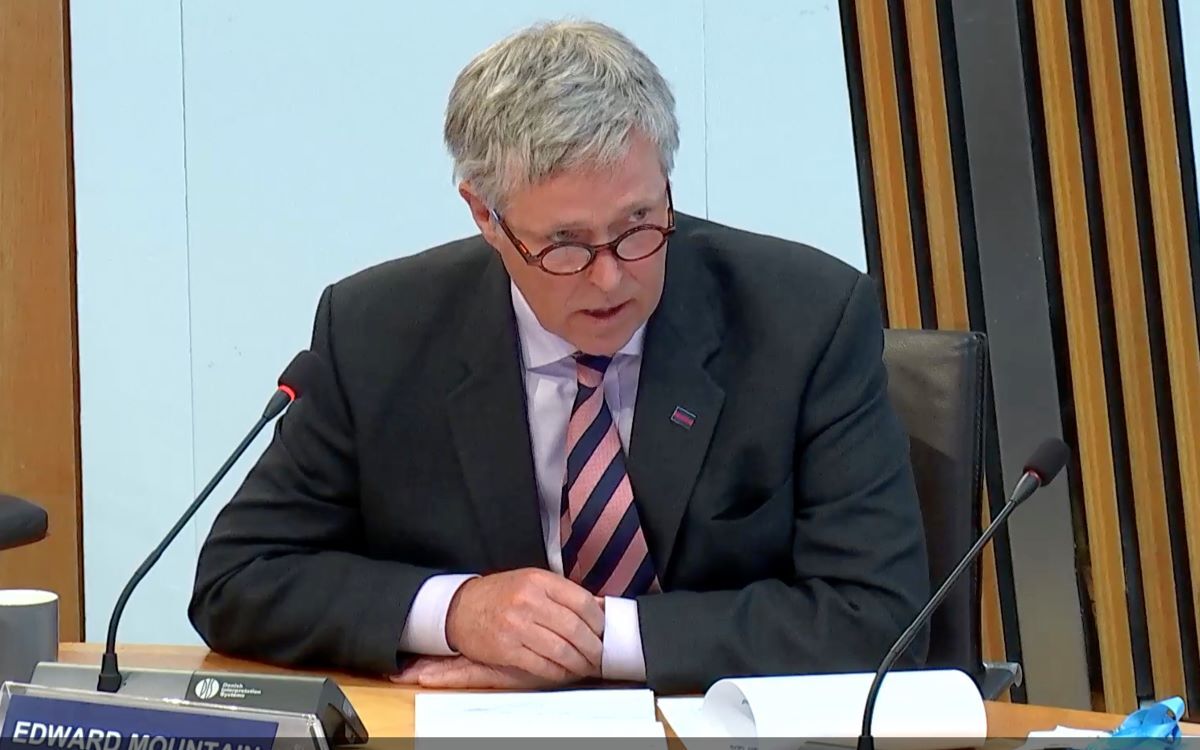
Sir Edward said: “I welcome the committee’s interest in salmon mortality rates, which reflects the work that the RECC undertook in 2018.
“I draw the Cabinet Secretary’s attention to recommendation 10 of that committee’s report, which refers to having ambitious, world-leading targets to reduce mortality levels. It goes on to say: ‘It considers that this should include appropriate mechanisms to allow for the limiting or closing down of production until causes relating to mortality are addressed’.
“At that stage, mortality was 3.8 million farmed fish, which was about 7% of the total. As the Cabinet Secretary suggested, it increased to about 17 million in 2022, which was about 25% of the total. It increased again the following year to 17.5 million, dropped slightly in 2024 and then shot up again in 2025. We now have mortality at around 20 to 25%.
“What figure will the Government set as an acceptable level – in percentage terms – of fish stock dying in pens in Scotland?”
Ms Gougeon replied: “We want to drive down mortality to the lowest possible levels.
“Are any of those levels acceptable? No. I want to see them driven down to the absolute lowest levels they can be. That is what our work to identify whether there are persistent issues and how best to address them has been about.”
Sir Edward countered: “The figures are remaining stubbornly high and well above the numbers the RECC considered to be totally unacceptable. There are about 6.5 million sheep in Scotland. If 1.5 million were found dead on the hills across Scotland every year, would the Government find that acceptable, or would it take action to deal with that?”
Ms Gougeon responded: “You are not comparing like with like. It is about driving down mortality to the lowest possible levels. There is significant investment and ongoing work to try to get ahead of problems where they exist and to drive down mortality.
“We have not set a threshold, and we are not considering doing so, because there are many different causes that can lead to mortality events. For me, the key focus is on how we are addressing those issues, whether action is being taken to prevent them from happening in the first place, and whether action is being taken following those events to ensure that they do not happen again. That is where the focus of the work is, and we are trying to drive them to the lowest possible levels.”
Sir Edward concluded: “If 25% of my cows died every year, I would be out of business, and I would not want to continue, because I would be sickened by it. I leave it at that.”
The verdict
Two weeks later, the RAIC’s Convener Finlay Carson delivered its verdict. “Overall, the committee is disappointed that across key areas of its inquiry recommendations, progress in future-proofing the salmon farming industry has not occurred with the urgency called for one year ago,” he wrote.
“The committee does, however, acknowledge the positive steps made towards some of its report’s recommendations, most notably the Scottish Government’s commitment to introduce baseline standards for the welfare of farmed fish through new official guidance under the Animal Health and Welfare (Scotland) Act 2006 Act.
“The committee is particularly concerned that its key recommendations aimed at addressing farmed fish mortality through strengthened regulation and oversight of farms and improved transparency, have not been accepted by the Scottish Government.
“The committee expects to see sites with persistently high mortality to be regulated effectively and does not agree with the analysis of the Scottish Government that this does not represent a systemic issue. Without meaningful actions to enhance the performance of the industry with regards to mortality, the Scottish Government risks eroding public confidence in this important sector.
“The committee also remains concerned by a lack of progress in implementing recommendations that seek to protect wild salmon populations from the risks posed by farmed salmon.
“The committee believes that a wide-ranging inquiry into wild salmon could be of significant value to understanding the reason for declining stock numbers and what actions could help to reverse this trend and has suggested that its successor committee undertakes this work in the next session.
“In conclusion, the committee stands by its report’s recommendations and expects the Scottish Government to set out a work plan in the early part of the next Parliament to deliver them to ensure the industry is placed on a sustainable footing and able to provide employment and prosperity for Scotland’s rural communities for future generations.
“Failure to act decisively and with urgency would allow commentary around the industry’s future to persist.”
Why not try these links to see what our Fish Farmer AI can tell you.
(Please note this is an experimental service)
You May Also Like






© 2026 Fish Farmer.