ao link

Collaborative research in Scottish salmon farming worth nearly £200 million, report finds
Innovation in Scotland’s salmon farming sector has surged to almost £200 million, an independent review has found.

Linked InXFacebook
Salmon Scotland tech 2 20260223
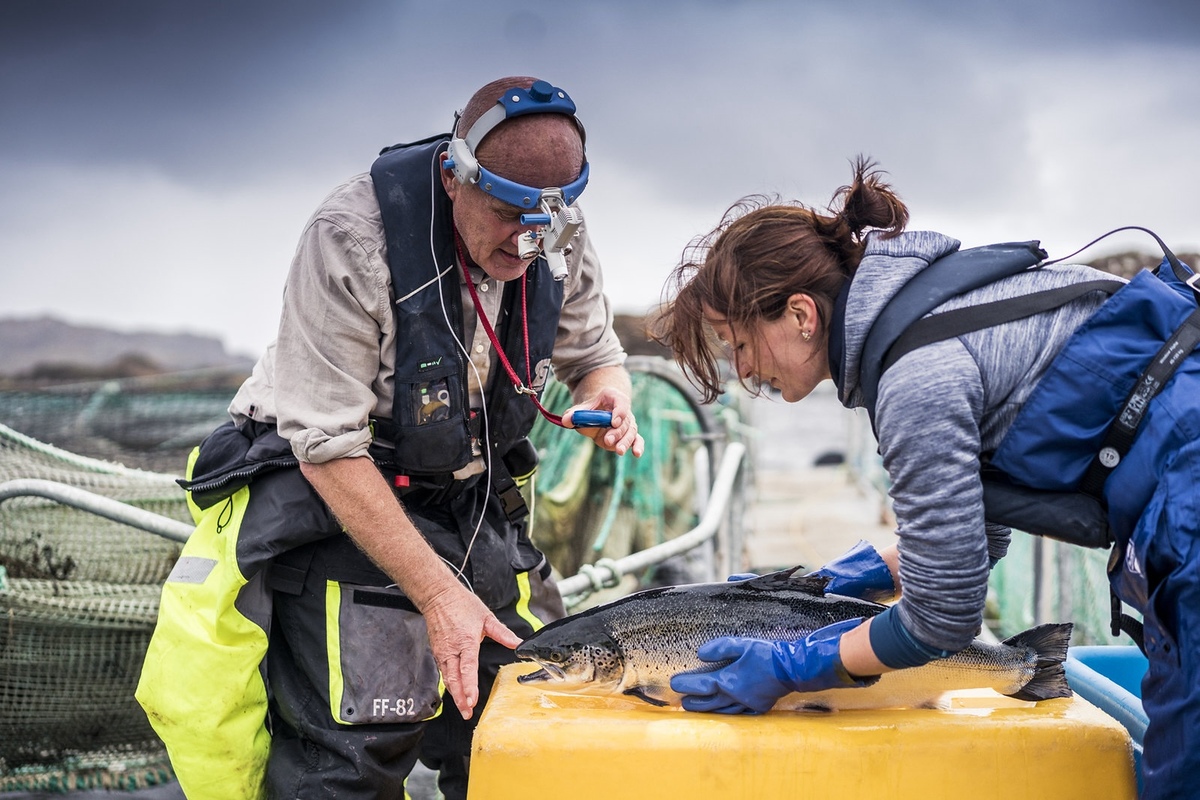
Researchers with salmon (photo: Salmon Scotland)

In total, 268 publicly supported projects worth more than £183m have been delivered since 2018 by salmon producers, supply chain businesses, universities, and public funders working in partnership.


The figure excludes projects funded entirely by companies, meaning overall spending on new technology is likely to be significantly higher.


The review, An Independent Review of Innovations in Scottish Aquaculture Since 2018, was conducted by research consultancy Frontline and commissioned by the Sustainable Aquaculture Innovation Centre (SAIC) and trade body Salmon Scotland. It concludes that innovation has broadened across every major area of salmon farming.


More than £83m has gone into fish health and welfare alone, supporting work on vaccines, diagnostics, welfare tools, and disease prevention.


Significant backing has also been directed towards sea lice management, including biological controls, new treatment technologies, and AI-enabled detection systems.


Other applications for technology highlighted in the report include enhanced genetic disease resistance, feeding optimisation and increased energy efficiency.


Dr Iain Berrill, head of technical at Salmon Scotland, said: “This review shows the scale of innovation now under way in salmon farming in Scotland.


“Almost £200m worth of publicly supported projects have been delivered over the past eight years, helping raise standards and strengthen performance across the sector.


“Salmon farmers in Scotland already operate to some of the highest standards in the world, but like any form of food production, we must invest in the latest research and innovation.


“Much of this investment has gone into fish health and welfare, from vaccines and diagnostics to technology that helps detect issues sooner and improve outcomes.


“There has also been significant progress in breeding, environmental monitoring, and tackling sea lice.


“Continuing to innovate will be essential to maintaining standards and building resilience for the future.”

Funding landscape Innovation Report Feb 2026 web
Scotland's aquaculture funding landscape (Graphic: Frontine)

Report welcomed

The findings have been welcomed by the Scottish Government.


Cabinet Secretary for Rural Affairs, Mairi Gougeon said: “I welcome this report’s endorsement of the positive impact of long running public investment in aquaculture innovation.


“Scottish salmon aquaculture is a highly agile sector, constantly adapting to the complex marine environment – and it is able to do that because of the focus collectively put on generating world class aquaculture science.


“The changing marine environment continues to present challenges, and Scotland’s track record of innovation indicates the sector will rise to those challenges to ensure the sustainable development of aquaculture into the future.”


Dr Suzanne Hamilton, Frontline director, commented: “This study shows how much aquaculture innovation activity has taken place in Scotland since 2018.


“Funding has supported real progress in fish health and welfare, environmental sustainability, and productivity, with research increasingly translating into practical outcomes.


“However, innovation is not instant. The impacts of research and development are often realised over several years as new approaches are tested and adopted.


“While support in recent years has been substantial, the future landscape is less certain, with fewer aquaculture-specific funding calls ahead.


“Continued, targeted investment will be important to maximise the benefits of what has already been achieved.”

Salmon Scotland tech 1 bridge_20260223
Technology is helping to monitor fish farm sites (photo: Salmon Scotland)

R&D supports fish welfare

Genetics and breeding programmes have advanced in parallel. One of the largest initiatives is the £8.5m Biotechnology and Biological Sciences Research Council (BBSRC) Business and Academia Partnership Prosperity Programme project, Drivers of Salmon Robustness.


Delivered with Mowi Scotland and the University of Edinburgh’s Roslin Institute, the programme aims to breed salmon that are more resilient to farming challenges.


Those involved say the work is already delivering practical results, from new tools to identify high-performing fish to technologies that enhance fish health and welfare, alongside education programmes in regional schools.


Across all the companies interviewed for the review, almost nine in 10 (88 per cent) said employment would have been lower without innovation activity, while three quarters (76 per cent) reported turnover would also have been reduced.


Much of the work has been carried out jointly by salmon producers and Scotland’s universities, spanning faster disease detection, improved breeding strategies, and enhanced environmental monitoring.


The review warns that innovation can still be slowed by short-term funding and lengthy regulatory processes, making it harder to test and adopt new ideas quickly.


It calls for longer-term support and faster routes to trials if momentum is to continue.


Other challenges highlighted in the report include: funding constraints and “fragmented” funding streams; infrastructure limitations such as a lack of trial facilities; collaboration and alignment issues when project partners have differing priorities (resolving these was seen as an important role for SAIC); and a shortage of specialts workers and skills.


Respondents to the study stressed the need to continue supporting collaborative research and development.


The report’s authors say: “Both public innovators and companies describe Scotland’s future funding landscape as tight uncertain and increasingly competitive across public and private funding support avenues. It was suggested that the Norwegian FHF [Norwegian Seafood Research Fund] model (levy-based funding for R&D) could be an approach Scotland could take, as well as a research farm concept where licenses are provided for commercial R&D activity. Both suggestions are aimed at making the future research landscape easier to navigate and access.”

WellFish Tech 1_20260223
Wellfish Tech

Case studies show benefits of research

Projects highlighted range from real-time alerts for harmful algal blooms to advances in fish health.


Among them is WellFish Tech, a University of the West of Scotland spin-out that provides rapid, AI-driven blood diagnostics, with results returned within 24 hours to help farmers monitor salmon health and welfare.


Faster results mean farmers can respond sooner if there are signs of stress or disease.


The report also highlights the NewDEPOMOD initiative, developed by the Scottish Association for Marine Science (SAMS) in close collaboration with SEPA, Salmon Scotland and various salmon farming companies. This fresh approach to assessing the seabed impacts of fish farming has transformed the regulatory system, the report says.


Also cited as examples are the Tiny Fish initiative, which has found a way to use humane stunning techniques and ensure undersized salmon can be used for value-added products after culling; and Ocean Ecology, which is using environmental DNA analysis in seabed surveys.


The innovation push is set to continue, the report says, with a £17m national aquaculture technology hub due to open at the University of Stirling this year.


Sarah Riddle, head of research and innovation at SAIC, concluded: “This report demonstrates the strength and maturity of Scotland’s aquaculture innovation system.


“The volume of activity and the speed at which new ideas are being developed show exceptional collaboration across industry and academia.


“The scale and breadth of activity highlight Scotland’s position as a global leader in aquaculture.


“Crucially, they show that these projects are delivering real‑world impact: better fish health, improved productivity, new technologies, enhanced environmental performance and climate readiness.


“Continued, strategic support for collaboration and innovation is essential to maintain this momentum.


“With the right long‑term investment, infrastructure and regulatory alignment, Scotland is well placed to build on its achievements and enhance the sector’s resilience, competitiveness and sustainability.”

Linked InXFacebook
Marine Operative - Bakkafrost Scotland Limited
Isle of BenbeculaIsle of Benbecula£35,677.16 per annum£35,677.16 per annum

Marine Operative - Net Washing North (7 days on/off) - Bakkafrost Scotland Limited
Isle of BenbeculaIsle of Benbecula£31,065.37 per annum£31,065.37 per annum

Senior Marine Operative - Net Washing North (7 days on/off) - Bakkafrost Scotland Limited
Isle of BenbeculaIsle of Benbecula£39,996.66 per annum£39,996.66 per annum

Marine Site Manager - Bakkafrost Scotland Limited
IV51 9DDIV51 9DD£63,551.13 per annum£63,551.13 per annum

Marine Operative - Net Washing South (7 days on/off) - Bakkafrost Scotland Limited
PA30 8ETPA30 8ET£29,033.05 per annum£29,033.05 per annum
Fish Farmer Magazine
IPSO
Facebook
X
Linked In

© 2026 Fish Farmer.