




Processing: The mighty thaw
Getting fish to overseas customers without sacrificing quality is arguably one of the most challenging parts of the salmon business, because time is so tight. In fact, it becomes a race against time, with the countdown beginning immediately the fish is brought out of the water.


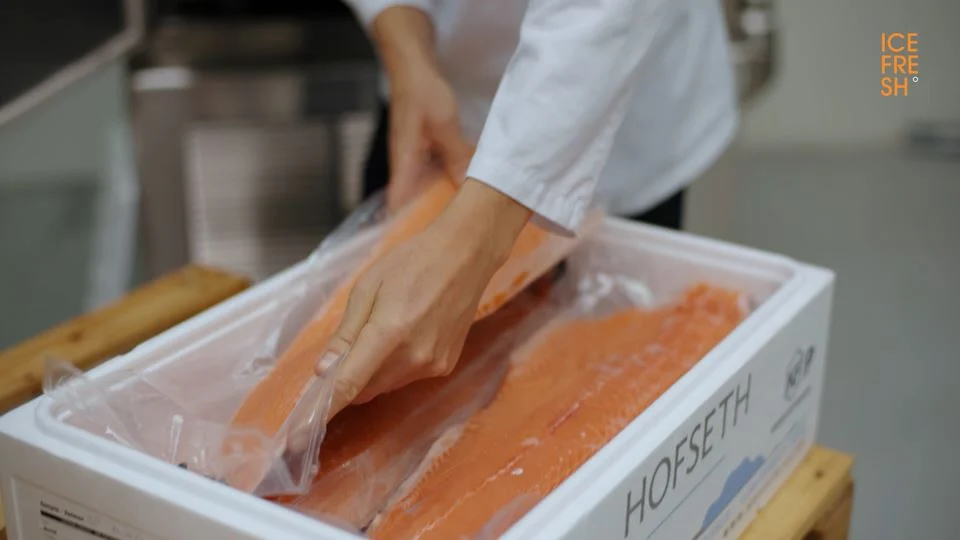
A delay of even a few hours can make all the difference to the freshness of the product, which is why companies often turn to freezing.
But many believe this affects quality. Frozen is not as good as fresh, they argue.
Now a new experiment involving the Norwegian scientific research organisation SINTEF and some of the country’s leading salmon farmers may be ready to change all that.
“Defrosting fish may seem simple, but it is actually an advanced interaction between heat, air flow and raw material quality,” says Trond Andresen, Senior Researcher at SINTEF.
“This is precisely where SINTEF’s strength lies – we can combine food technology with in-depth knowledge of heat transport and flow science. The adaptive process we are developing will allow the system to find the best way to defrost, regardless of the type of fish, cut and packaging.”
He adds: “For me, it is inspiring to see how theory and computer models can be turned into practical solutions that both improve quality and save energy and emissions.
“And it may sound feasible, but there was no shortcut to the answer to how it could be done in practice. That is, how frozen fish ‘become fresh again’.”
Anders Haugland is the researcher who delved into how to thaw frozen fish in a way that makes it taste as fresh as it did on the quayside.
He says the idea is that, if we can have the fish as close as possible to the customer before the “window” in which it is still fresh starts to close, it will be good for everyone.
Haugland adds: “But then we have to stop time in a way. And we do that with a freezer. But that brings with it some challenges when you are defrosting.
“Everyone knows that once the fish has thawed on the kitchen counter, it is something completely different.”
So what the researchers did was to look for a way to thaw the fish so it retained all its fresh qualities.
“It is possible to freeze something and then thaw it to optimal quality long afterwards,” says Haugland. “It is done every day by those who work with in vitro fertilisation. Our challenge was to create a system that does this with fish fillets.
“We figured out the process of thawing fish properly a while ago. But it’s not enough to thaw it properly, we also have to put this into use, and get it all the way to the customer. A good product is useless without a place in the value chain for the raw material,” Haugland adds.
The work began some years ago with China as the obvious destination for the experiment, because it takes some time for the fish to get there.
Haugland says the team managed to create a functioning thawing unit in Norway, but the country was not suitable so the solution was to acquire the best quality salmon, freeze it, and send it straight to China!
Haugland says that “thawing hubs” were to be set up over there, and the salmon was launched as IceFresh via the Chinese online store Alibaba.
But then geopolitics put a damper on the project. The prominent critic and human rights activist Liu Xiaobo had won the Nobel Peace Prize which angered Beijing. Suddenly Norway and Norwegians and their fish became hugely unpopular.
Things looked quite dark for a while, but on Christmas Eve 2021, salmon farm owner Roger Hofseth signed a napkin agreement with the company, saying that IceFresh was a crucial addition to optimising the value chain.
“Up until now, we have focused on frozen products, and had therefore already cut out air freight,” Hofseth says.
“IceFresh gives us a fantastic opportunity, because we can now sell the products so-called ‘refreshed’, in the fresh produce counter with the good and fresh quality [seafood]. It offers so many advantages that we are convinced that the entire industry will follow suit,” he adds.
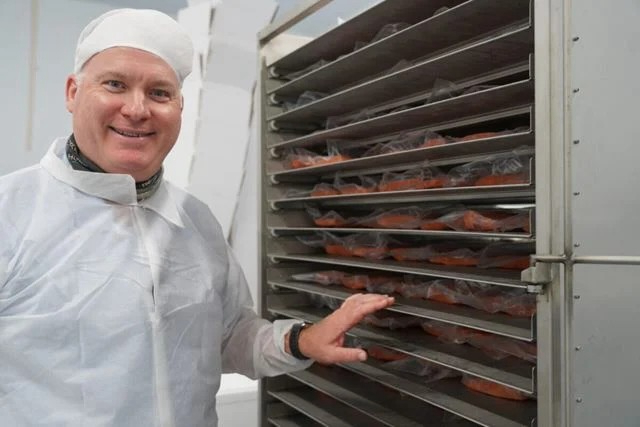
Rapid thawing on demand
The seafood group Hofseth may not be as large as SalMar or Lerøy, but they sell salmon and trout worth several billion kroner annually to their main market in the United States.
Roger Hofseth says that IceFresh is a crucial addition to optimising the value chain: “Up until now, we have focused on frozen products, and had therefore already cut out air freight.
“It offers so many advantages that we are convinced that the entire industry will follow suit.”
The next stop was Florida, where the team had made contact with one of the larger grocery chains, but interest was limited.
Then a few months later, another supplier came on the scene. They wanted a comprehensive full-scale test, which was carried out in late summer 2024.
Some 230,000 portions of thawed salmon were sent out along with the same amount of fresh salmon.
The end users – the chefs and the customers – were asked about the quality. The result was a resounding success, confirming the logistical gain: by purchasing, freezing and transporting the salmon by boat, high-quality fish can be thawed no earlier than two days before it is available to the customer.
But the major customer in this case thought the existing cabinets were too clunky, so a new thawing plant was required, to be ready in Chicago by Christmas 2024.
Since neither the technology nor the financing for the future thawing tunnels were in place, the factory had to start with the classic, smaller thawing cabinets.
After both rebuilding and approving the premises, and recruiting people to run the thawing operations, they managed to deliver the very first consignment of newly thawed salmon on Christmas Eve 2024.
During this process, it had become clear that extensive research and development was required to develop tunnel-based thawing plants.
Then SINTEF was linked more closely to establish an IPN (Innovation Project in Business). The team now became a powerful consortium consisting of IceFresh, MMC First Process, Hofseth International and SINTEF.
The players teamed up to develop thawing tunnels, and through the project, which was named “REFRESHING”, secured support from the Research Council.
They were now able to combine expertise in seafood processing, food science, thermodynamics, fluid flow and system optimisation.
“The goal is to develop groundbreaking technology for large-scale thawing of fish, which preserves all aspects of the fish’s quality combined with maximum energy efficiency and productivity in the thawing process,” says Trond Andresen, Senior Researcher at SINTEF.
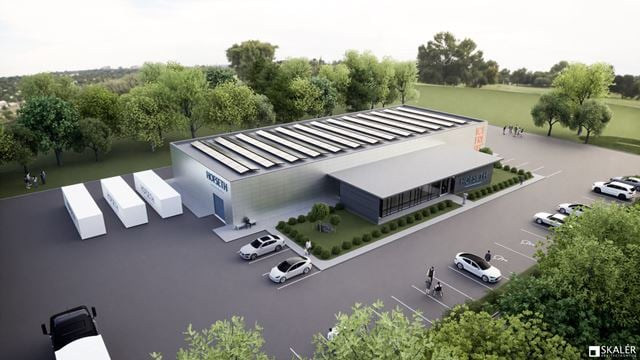
This year, a thawing plant will open in Miami, and the facility already established in Los Angeles will be upgraded to incorporate the tunnel solution, as the first full-scale pilot financed by Innovation Norway and equity.
Despite the progress, it is still a challenge to achieve coherence in the value chain. One of the great paradoxes of Norwegian exports is that it mostly flies hundreds of tons of salmon – to the US and Asia.
If all this fish were instead frozen, transported by boat and then thawed, argue the project partners, it would save annual emissions of six million tons of carbon dioxide.
“The benefits of doing it this way are so great that this change will come anyway,” believes Roger Hofseth. “When we stop flying fish, the seafood industry’s footprint will be dramatically reduced.”
He says they now need to build capacity quickly, so that large volumes can be realised in the markets.
“A lot happens in a short time, and both the expertise and the thawing capacity must be shared with the entire industry,” he says.
Hofseth paints a picture of thawing hubs around the world, which he believes will make airfreighting fish a thing we read about in history books, and fresh fish something everyone can access.
Why not try these links to see what our Fish Farmer AI can tell you.
(Please note this is an experimental service)
You May Also Like



© 2026 Fish Farmer.